

Unmasking Tyranny: ‘Daredevil: Born Again’ Season 2 Ignites a Battle for Justice in a World Too Close to Our Own
The highly anticipated return of “Daredevil: Born Again” to Disney+ arrives a year after its dramatic resurrection, proving itself not just a thrilling superhero saga, but a searingly relevant mirror held up to contemporary society. As viewers plunge back into the gritty, rain-slicked streets of Hell’s Kitchen, they are confronted with a chillingly familiar landscape, one where fundamental freedoms are eroded and the line between order and oppression blurs into oblivion. The series, renowned for its grounded realism and moral complexities, doubles down on these tenets in its second season, weaving a narrative that feels profoundly unsettling in its echoes of real-world anxieties.
At the heart of this new dystopian New York City stands Mayor Wilson Fisk, brought to life with terrifying gravitas by Vincent D’Onofrio. Having ascended to the city’s highest office, Fisk has wasted no time in consolidating his power, unleashing a draconian crackdown on perceived disorder. His declaration of martial law is not merely a political maneuver; it is a calculated assault on the very fabric of civil society, designed to dismantle any opposition to his authoritarian vision. Under this new regime, the act of vigilantism, once a desperate measure against a failing system, is now outlawed entirely, criminalizing those who once stood as the city’s last hope.
Fisk’s most formidable tool in this campaign is the Anti-Vigilante Task Force (AVTF), a brutal and heavily militarized police unit operating with near-impunity. From its inception, the AVTF embodies the chilling efficiency of an unchecked state apparatus. Citizens are routinely locked up without due process, their rights dismissed as inconvenient obstacles to Fisk’s vision of “order.” Protests, the bedrock of democratic dissent, are met with disproportionate violence, painting a stark picture of a city under siege by its own protectors. The creators’ foresight in crafting this narrative, reportedly nearly two years prior to its release, lends an eerie prescience to the unfolding events. The AVTF’s tactics, its disregard for civil liberties, and its targeting of marginalized groups evoke disturbing parallels to real-world enforcement agencies, notably reminiscent of the actions of ICE in detaining individuals and the use of force against demonstrators. It’s a sobering reminder that while the show’s premise is fantastical, its underlying themes are anything but.
Brad Winderbaum, executive producer and head of Marvel Television, touched upon this uncomfortable timeliness at the New York premiere. “Any kind of reflection on reality is coincidental, but Stan Lee said Marvel reflects the world outside our window. Sometimes things just take on a life of their own,” Winderbaum remarked. His statement underscores a fundamental principle of Marvel storytelling: that the greatest superhero narratives often serve as allegories for contemporary societal struggles. Stan Lee’s vision of heroes grappling with complex moral dilemmas in a world recognizable to readers has always been a cornerstone of the Marvel universe. In “Daredevil: Born Again,” this philosophy finds its most stark and unfiltered expression, transforming the show into a potent commentary on power, justice, and the resilience of the human spirit in the face of tyranny. The coincidence of the storyline’s resonance with current global events only amplifies its impact, making the series feel less like escapism and more like a visceral exploration of the world we inhabit.
The Season 2 premiere wastes no time in illustrating the grim realities of Fisk’s New York. The AVTF, far from merely targeting costumed heroes, systematically dismantles local businesses, ostensibly under the guise of maintaining order, but effectively destroying the livelihoods of ordinary citizens. This tactic, designed to instill fear and break the spirit of the populace, reveals the insidious nature of Fisk’s reign – it’s not just about controlling crime, but controlling every aspect of life. Vigilantes, once symbols of hope, are now hunted relentlessly. The premiere reveals that figures like Swordsman, played by Tony Dalton, have already been apprehended, their defiance met with imprisonment. The fate of many others remains a grim unknown, painting a picture of a city where the forces of good are systematically neutralized. Even the formidable Jon Bernthal’s Punisher, a brutal force for justice in his own right, managed to escape his imprisonment only through the events of the Season 1 post-credits scene, highlighting the sheer overwhelming power of Fisk’s new regime.
Vincent D’Onofrio, whose portrayal of Wilson Fisk has consistently been a masterclass in nuanced villainy, shared his profound thoughts on the show’s themes. “Being a New Yorker, what we are doing in the second season would truly be frightening for a New Yorker,” D’Onofrio stated, emphasizing the visceral fear the scenario would inspire. “There are aspects about what we do now in the second season that are scary to think about if they were real.” D’Onofrio’s words carry weight, underscoring the character’s chilling effectiveness not just as a criminal mastermind, but as a political manipulator who weaponizes fear and order. His Fisk is not merely a physically imposing figure; he is an ideologue, convinced of his own righteousness, and this conviction makes his reign all the more terrifying. The actor’s deep understanding of the character and his environment allows him to convey the gravity of Fisk’s actions, making the fictional plight of New York City feel remarkably authentic and disturbing.
In this climate of enforced silence and pervasive propaganda, the role of independent journalism becomes paramount, and dangerously so. Genneya Walton’s BB Urich, a character whose lineage hints at a legacy of truth-seeking, is introduced navigating the perilous landscape of information control. She is seen publishing pro-Fisk propaganda videos, narratives that boast of plummeting crime rates and a city brought back from the brink, effectively whitewashing the brutal realities of martial law. This portrayal highlights the insidious power of state-controlled media to manipulate public perception and legitimize authoritarian rule. Countering this narrative is the indefatigable Karen Page, portrayed by Deborah Ann Woll. With Matt Murdock conspicuously absent, Karen steps into an even more active role, risking her own safety to go undercover and learn inside secrets from BB Urich. Her unwavering commitment to uncovering the truth, even amidst immense personal danger, positions her as a crucial voice of resistance, reminding audiences of the vital role a free press plays in holding power accountable, especially when that power is tyrannical.
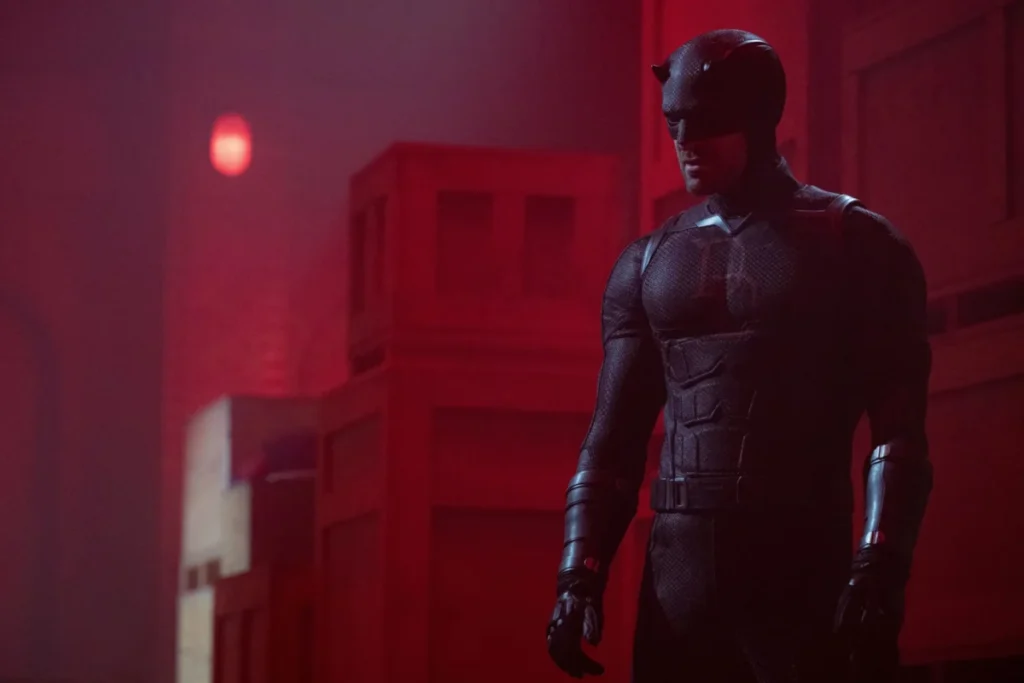
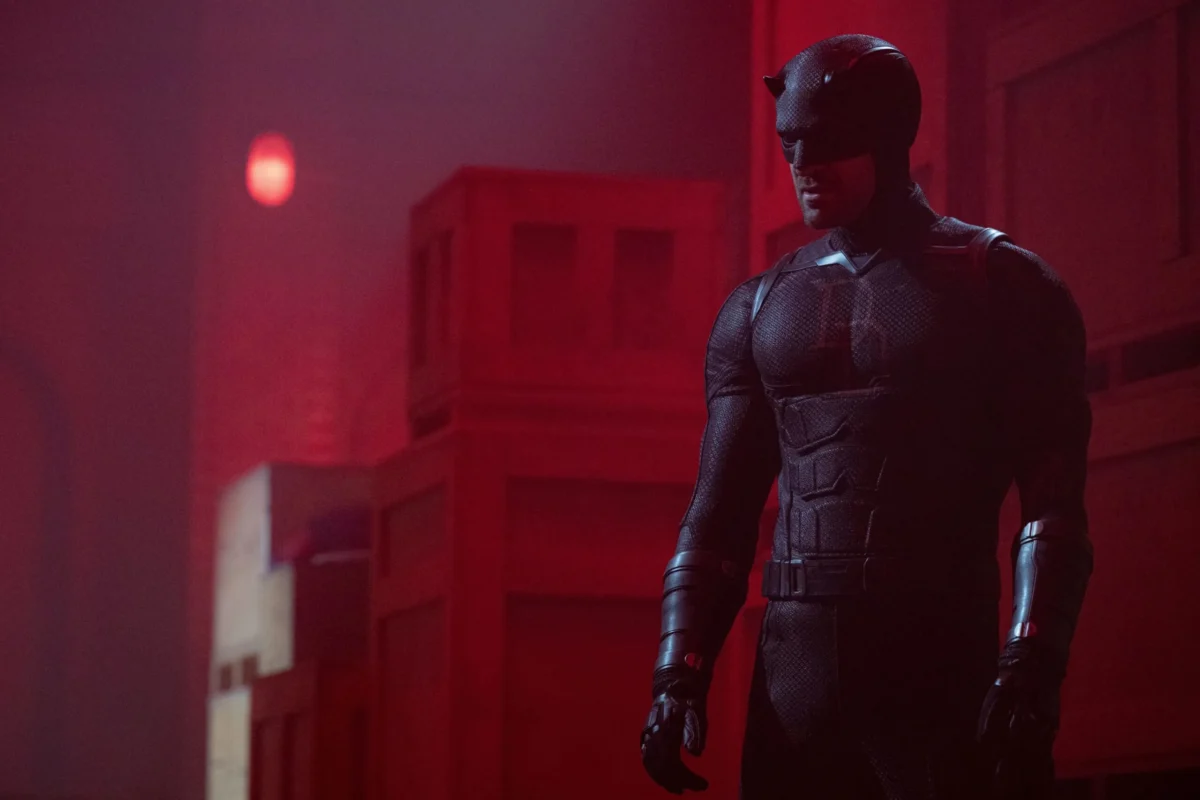
Despite the overwhelming odds and the personal toll, Daredevil, the masked vigilante (Charlie Cox), remains a beacon of defiance. Even with Matt Murdock’s whereabouts shrouded in mystery, the Devil of Hell’s Kitchen continues his relentless fight against Kingpin’s pervasive influence. The Season 2 premiere opens with a breathtaking display of Daredevil’s prowess and unwavering moral compass. He engages in a thrilling, bone-jarring battle aboard a cargo ship navigating the murky waters of the East River, interrupting a clandestine operation to smuggle illegal firearms. This high-stakes confrontation immediately sets the tone for the season, establishing that even with Fisk in power, Daredevil will not be silenced. The target of this raid is a shipment ordered by a mysterious new power player, Mr. Charles, making his Marvel debut with Matthew Lillard’s nuanced performance.
Mr. Charles immediately establishes himself as a figure of considerable intrigue and potential menace. Though little is revealed about his background, his immediate name-dropping of Julia Louis-Dreyfus’s CIA Director Valentina Allegra de Fontaine hints at deep, clandestine connections within the higher echelons of global power. This casual mention is a significant moment, signaling a wider integration of “Daredevil: Born Again” into the broader Marvel Cinematic Universe. Valentina Allegra de Fontaine, a shadowy figure known for recruiting individuals for a mysterious agenda, suggests that Mr. Charles operates far beyond the street-level concerns of Hell’s Kitchen, possibly linking him to larger, more complex geopolitical schemes. This expansion of the narrative scope suggests that Daredevil’s fight is not just against local corruption, but against a sprawling network of influence that extends far beyond New York City, raising the stakes considerably for the Man Without Fear.
Matthew Lillard, marking his impressive Marvel debut with the enigmatic Mr. Charles, offered a powerful reflection on the series’ resonance. “It’s incredible to be a part of that kind of project that’s reflecting what’s happening in the world right now,” Lillard shared, articulating the collective sentiment surrounding the show’s unexpected timeliness. He continued, “Our hope is that, in some small part of us, you’re sitting at home and realizing we need superheroes. And that’s common people. People standing up for what’s right in the world. Standing up for your neighbors and your friends and doing what’s right. Hopefully, there’s a piece of this that is a wake up call, that’s a battle cry for everyday citizens to do the right thing and fight the oppression that a lot of people right now are feeling in America.” Lillard’s words transcend the realm of comic book entertainment, transforming the series into a poignant call to action. His vision of “common people” as superheroes speaks directly to the core message of individual agency and collective resistance against systemic injustices, encouraging viewers to find their own power in challenging oppressive forces.
The premiere culminates in a brutal, visceral fight sequence that epitomizes the show’s unflinching approach to violence and its commitment to depicting the harrowing realities of its world. A group of Kingpin’s officers, part of the newly empowered AVTF, violently breaches the apartment of ex-NYPD Officer Cherry (Clark Johnson). Their intel suggests Cherry has ties to the elusive vigilante, and they proceed to tie him up and subject him to a merciless beating, a stark demonstration of the task force’s brutality and disregard for human dignity. Just as Cherry’s life hangs by a thread, Daredevil swoops in, a whirlwind of red and black, to save him. He pummels the corrupt officers with his characteristic ferocity, each punch a bone-jarring testament to his skill and rage. However, a moment of vulnerability, born from his heightened senses, nearly costs him everything. As he hears Cherry’s faltering heartbeat, a distraction that momentarily breaks his focus, Daredevil loses his tactical advantage. The officers seize the opportunity, cornering the hero and beginning to unmask him, threatening to expose his identity to the world.
In this critical, suspenseful moment, a hail of projectiles suddenly ricochets through the window, striking the officers with lethal precision. Each projectile finds its mark, puncturing vital organs and neutralizing the threat. The shocking arrival of Wilson Bethel’s sharpshooter Bullseye, a character whose previous appearances left an indelible mark, saves Daredevil from certain exposure and capture. His return is a pivotal and dramatic twist, signaling that the landscape of Hell’s Kitchen is about to become even more complicated and dangerous. However, even with Bullseye’s timely intervention, Cherry’s life remains precariously balanced, underscoring the high stakes and constant peril that permeate this new season.
If there was any lingering doubt from its initial season, “Daredevil: Born Again” Season 2 definitively asserts its willingness to get its hands dirty, both literally and figuratively. The series is by far the most violent entry on Disney+, pushing the boundaries of what is typically seen on the platform. It unflinchingly depicts bone-crunching punches, brutal beatdowns, and the stark consequences of unchecked power. The dialogue, too, matches the intensity of the action, dropping its fair share of F-bombs, further cementing its mature rating and gritty authenticity. This commitment to a raw, uncompromising portrayal of its world, reflecting the darkness and moral ambiguities of the real world, is a testament to the creative team’s vision. Brad Winderbaum expressed profound gratitude for Disney’s unwavering support in allowing them to explore these mature themes and tones as they embark on shooting Season 3.
“Disney is a company that’s run by the artists. It really is,” Winderbaum affirmed, challenging common perceptions of the corporate giant. “It sounds corny, but I know these people and I really feel like it’s as true as it was in Walt’s time. They really support the creatives. It’s a difficult thing to do at this scale, but they’ve never once told us we can’t do something.” This insight from Winderbaum is crucial, revealing a creative freedom often not associated with a company known for its family-friendly entertainment. It suggests a significant evolution in Disney’s content strategy, allowing for more mature and challenging narratives to find a home on its streaming platform. This artistic latitude is precisely what enables “Daredevil: Born Again” to delve into such complex and timely themes with the depth and visceral impact that fans have come to expect, ensuring that the Devil of Hell’s Kitchen continues to fight not just for his city, but for the very soul of justice itself.