


**SNL UK’s Ambitious Debut Captures National Attention, Signaling a New Era for British Sketch Comedy**
The United Kingdom’s television landscape recently witnessed a significant cultural moment with the highly anticipated premiere of “Saturday Night Live U.K.” Airing on the pay-TV channel Sky One at 10 p.m., the inaugural episode garnered a respectable 226,000 viewers, a solid opening statement for a show carrying the weight of such an iconic American legacy. This initial viewership translated into a 3.2% share of the total television audience at the time, according to official BARB (Broadcasters’ Audience Research Board) figures, which serve as the industry standard for audience measurement in the UK.
The decision to adapt “Saturday Night Live” for a British audience was a bold move, given the original show’s nearly five-decade history as a cornerstone of American television, famous for its live sketch comedy, political satire, and musical performances. Since its debut in 1975, the U.S. version has launched countless comedic careers, influenced generations of comedians, and become a barometer of American pop culture and political discourse. Bringing this format across the Atlantic presented a unique set of challenges and opportunities, demanding a careful balance between preserving the original’s spirit and infusing it with a distinct British sensibility.
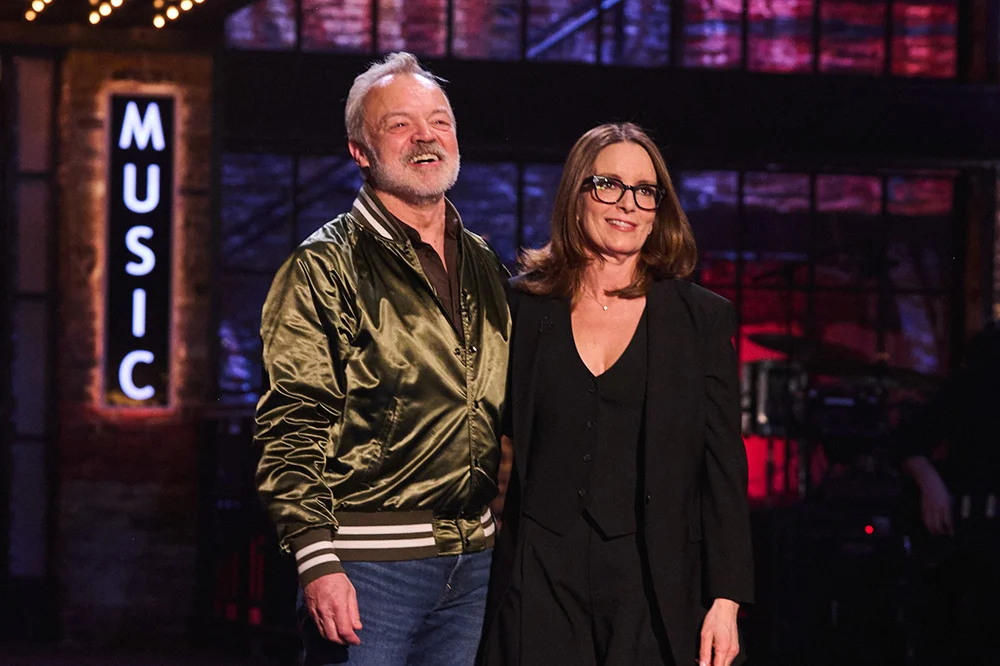
The premiere episode of “SNL U.K.” arrived with considerable fanfare, largely due to its star-studded lineup and the esteemed figure overseeing its production. Headlining the show was the incomparable Tina Fey, a celebrated alumna of the original “Saturday Night Live” as both a performer and its first female head writer. Fey’s comedic genius, sharp wit, and extensive experience with the live sketch format made her an ideal choice to anchor the British debut, lending immediate credibility and star power. Joining her was the beloved British television personality Graham Norton, known for his charismatic interviewing style and quick humor, further cementing the show’s appeal to local audiences. The entire venture was overseen by the legendary Lorne Michaels, the executive producer and creator of the original “Saturday Night Live,” whose involvement underscored the seriousness and ambition behind the UK adaptation. His oversight was a clear signal that this was not merely a superficial rehash but a genuine attempt to establish a high-quality, authentic British iteration.
In the competitive 10 p.m. slot, “SNL U.K.” demonstrated its immediate potential by outperforming a major terrestrial rival. It successfully drew more viewers than Channel 4, which was airing the blockbuster film “Mission: Impossible – Rogue Nation,” a formidable competitor that attracted 215,000 viewers in the same time period. This direct victory against a popular movie underscores the drawing power of the live comedy format and its prominent guests. Furthermore, the new show’s performance on Sky One was almost four times greater than “A League of Their Own,” a popular sports-themed panel show that is typically Sky’s biggest entertainment offering. This comparison highlights “SNL U.K.’s” impressive immediate impact within Sky’s own programming portfolio. The British iteration also significantly surpassed the viewership for the U.S. version of “SNL” which airs on Sky Comedy channel, having registered a modest 5,000 viewers the previous week. This stark contrast illustrates a clear appetite for a localized version of the format, tailored to British tastes and featuring recognizable UK talent alongside international stars.
While these numbers are encouraging for Sky One, it’s crucial to contextualize them within the broader UK television landscape. The 10 p.m. slot is notoriously dominated by news programming, particularly on BBC One, which regularly commands a massive audience. On the night of “SNL U.K.’s” premiere, the BBC One news led the time period with nearly 2 million viewers and an impressive 25% share, demonstrating the enduring power of public service broadcasting for news consumption. Against this backdrop, “SNL U.K.’s” 226,000 viewers represent a strong performance for a pay-TV channel launching a new, ambitious entertainment format, especially one that deviates from traditional British comedy structures. It indicates that a dedicated audience is willing to seek out premium, live sketch comedy.
Beyond the raw viewership data, critical reaction to “SNL U.K.” offered a tentatively positive, albeit nuanced, assessment. Reviewers largely acknowledged the inherent challenges of translating a culturally specific American institution for a new audience, while also praising the ambition and potential demonstrated in the premiere.
Nick Hilton, writing for The Independent, awarded the show three stars out of five, a rating that suggests a blend of success and areas for improvement. Hilton’s comments were insightful, noting that the episode featured “some hits, some misses, and a bang-on Princess Di impression.” This observation speaks to the unpredictable nature of live sketch comedy, where not every joke can land perfectly, but where standout moments can truly shine. The “Princess Di impression” specifically hints at the kind of culturally resonant, perhaps even daring, satire that the British version aims to deliver, tapping into figures deeply ingrained in the national consciousness.
Hilton further elaborated on the critical perspective, urging patience and a broader view. “Judging a show like ‘SNL’ off its opening episode is foolish,” he wisely observed, recognizing that the format thrives on evolution and the development of its ensemble cast over time. He commended the show’s discernible spirit, adding that “What ‘SNL UK’s’ opening episode does demonstrate is a willingness to push the envelope, to risk bad taste.” This willingness to embrace edginess and challenge comedic boundaries is a hallmark of the original SNL and suggests the UK version is not shying away from controversial or provocative humor. Hilton concluded with a hopeful outlook, stating, “Borrowing a beloved American format might feel a bit stale, but there are notes of new ingredients that could offer something fresh.” This implies that while the format itself is familiar, the British team is actively working to infuse it with unique elements that cater to local humor and current events, preventing it from becoming a mere imitation.
Similarly, Lucy Mangan of The Guardian also gave the show a three-star rating, echoing the sentiment of cautious optimism. Mangan’s review conveyed a sense of relief and pleasant surprise that the show managed to land on its feet. “The general feeling, I think, will be that the inaugural episode of ‘Saturday Night Live U.K.’ […] did work,” she stated, indicating that despite potential reservations, the show largely achieved its goal. She candidly added, “It could have been a lot, lot worse. And it could have been a lot better… honestly – it felt refreshing to see an ambition/piece of madness like retooling a legacy U.S. brand for this septic isle even being attempted.” Her use of the self-deprecating term “septic isle” (a British colloquialism for the UK) humorously underscores the perceived challenge of adapting such a monumentally American show for a British audience, highlighting the sheer audacity and ambition of the project. Mangan’s commentary ultimately celebrates the brave attempt itself, acknowledging the significant risk involved in such a transatlantic cultural transfer of entertainment.
The launch of “Saturday Night Live U.K.” represents more than just another new television show; it’s a significant cultural experiment in transatlantic entertainment. The initial viewership figures and critical reception suggest that while the road ahead will undoubtedly involve refinement and adaptation, the show has successfully laid a foundation. Its ability to attract a substantial audience on a pay-TV platform, outperforming direct competitors and internal benchmarks, points to a clear demand for its unique blend of live sketch comedy, celebrity hosts, and musical guests.
The presence of titans like Tina Fey and Lorne Michaels, combined with local stars like Graham Norton, creates a potent mix that promises both familiarity and fresh perspectives. For Sky One, “SNL U.K.” is a bold investment in premium, original entertainment designed to elevate its profile and offer viewers something distinct. As the series progresses, the true test will be its ability to cultivate a loyal audience, develop its own stable of comedic talent, and carve out a unique identity that resonates deeply with the British public, much as its American predecessor has done for generations. The journey of “Saturday Night Live U.K.” has just begun, and its early performance indicates a promising, albeit challenging, path toward becoming a staple of British television.