



In an era where cultural conversations are often fraught with tension and misinterpretation, the title of Raviv Ullman and Greg Yagolnitzer’s debut feature, “Drag,” might initially lead one down a path of predictable assumptions. Given the current discourse surrounding gender identity and expression, it would be understandable for audiences to anticipate a film delving into the complexities of “gender ideology” or the societal implications of individuals challenging traditional sartorial norms. However, “Drag” masterfully subverts these contemporary expectations, cleverly drawing its provocative title not from the vibrant world of drag performance, but from a far more primal, visceral action: the literal, arduous task of pulling a dead-weight object across the ground. And in this film’s darkly comedic narrative, that “object” happens to be a woman – a protagonist, in fact, who is far from being the primary victim of the burgeoning serial killer plot. While the film doesn’t shy away from grievous bodily harm, nonconsensual drugging, and murder, it conspicuously—and perhaps ironically—avoids the very “unwholesome” elements that its title might deceptively suggest, like a man in a dress.
Yet, for those seeking a different kind of visual intrigue, the film does offer its own eccentricities, including several scenes featuring actor John Stamos in various states of undress. Stamos’s character, however, remains firmly rooted in a heterosexual framework, his desires manifesting in a uniquely peculiar manner that only adds to the film’s unsettling charm. At its core, “Drag” is predominantly a captivating sister act, a dynamic central to its narrative and emotional landscape. The film stars Lizzy Caplan and Lucy DeVito as a pair of siblings whose already fractious relationship is severely tested when a seemingly straightforward house robbery spirals catastrophically out of control. This confined, crisis-driven premise, while potentially lending itself to a shorter format, is skillfully expanded by Ullman and Yagolnitzer, who manage to sustain a palpable tension and a razor-sharp, edgy humor throughout its nearly 90-minute runtime. The result is an enthusiastically nasty little bon-bon of caustic entertainment, perfectly positioned to resonate with audiences as an opening-weekend premiere within the coveted Midnighter selection at SXSW, a festival known for showcasing genre-bending and audacious cinema.
The film delves deeply into the raw, often uncomfortable familiarity of lifelong familial conflict, particularly evident in the unnamed protagonists. A revealing final cast scroll designates Caplan’s character simply as “Fuckup” and DeVito’s as “Sister.” This deliberate anonymity, extending to two other dramatic personae labeled merely “Man” and “Woman,” serves to universalize their struggles and archetypal roles, allowing the audience to project their own experiences onto these broadly drawn figures. The “Fuckup” is the quintessential ne’er-do-well, a bartender navigating a precarious existence through dubious side gigs and an equally questionable romantic history. Her life is a constant tightrope walk, marked by impulsive decisions and a perpetual need for bailouts. Her sibling, the “Sister,” by contrast, embodies a semblance of stability and responsibility. She’s a comparatively upstanding adult, with a husband, a daughter, and a restaurant business that anchors her to a more conventional life. Yet, despite her efforts to maintain order, she finds herself reluctantly — and repeatedly — ensnared in her sister’s chaotic orbit. This time, her role is to serve as driver and lookout while “Fuckup” attempts to break into the home of “some guy who owes me money.”
The “Sister,” seasoned by years of her sibling’s fabrications, harbors a well-founded suspicion that this claim of an unpaid debt is, in all likelihood, a convenient fib. Initial moments of the heist proceed with an unsettling ease; the isolated rural house, brimming with valuable objets d’art, appears surprisingly devoid of any visible security measures. However, this fleeting sense of calm is shattered when “Fuckup,” now inside, communicates a wordless squeal of agony over the walkie-talkie. Forced to investigate, “Sister” discovers Caplan’s character immobilized in an upstairs jacuzzi bathtub. In a moment of pure, absurd misfortune, while reaching for an item to pilfer, she has managed to fall and severely throw out her back. This incident marks the first domino in a cascading series of escalating misfortunes, transforming a simple robbery into a harrowing ordeal.
With her sister barely able to move, the clock begins ticking. They have a mere half-hour before the homeowner is expected to return, necessitating a swift and strategic extraction. As “Sister” attempts the arduous task of “dragging” her injured sibling across the floor, an unnoticed protrusion exacerbates the injury, transforming temporary acute discomfort into a genuine medical emergency. This new, critical problem significantly delays their exit, forcing them to hide as the sole occupant, the aforementioned “Man” (John Stamos), makes his perilous return. He is a successful painter of abstract female portraits, his home a gallery of his enigmatic works. The intruders find themselves perilously close to discovery when a doorbell chime signals an unexpected arrival. Stamos’s character, it turns out, has a date this evening: a younger woman (Christine Ko), an aspiring artist herself, whom he met through a dating site.
The film then takes a darker turn, serving as a chilling cautionary tale about the perils of accepting invitations from strangers, particularly for women. As “Responsible Sis” reports with growing horror, “He’s roofied a girl or something!”, the true sinister nature of their host begins to unravel. It becomes chillingly clear that numerous women have likely entered this seemingly idyllic household, but disturbingly, few, if any, have ever made it out alive. The narrative pivots sharply from a botched robbery to a desperate fight for survival, forcing our two heroines to not only rescue themselves from the clutches of a serial predator but also to save the oblivious third party, all while meticulously maintaining the illusion of their undetected presence. This shift in stakes amplifies the tension exponentially, cementing the film’s identity as a dark thriller peppered with macabre humor.
Initially, the relentless bickering between the protagonists – one perpetually exasperated by her sister’s self-inflicted messes, the other resentful of her sibling’s perceived moral superiority – might seem like a narrative misstep, potentially alienating viewers. However, Ullman and Yagolnitzer’s script is remarkably eventful, ensuring that the squabbling functions more as a comedic counterpoint and a reflection of their deep, complex history, rather than an irritating dominant element. Lizzy Caplan delivers a tour-de-force performance, skillfully navigating a gamut of punishing physical pains that often border on slapstick. Her portrayal is both physically demanding and emotionally nuanced, capturing the absurdity and agony of her character’s predicament. Lucy DeVito, as the long-suffering sister, masterfully blends exasperation with an underlying current of profound sympathy. Despite her character’s fervent desire to abandon her chaotic sibling, DeVito subtly conveys the unbreakable, albeit strained, bond that ultimately prevents her from doing so. Christine Ko, familiar to audiences from the FX sitcom “Dave,” provides a brilliant comedic turn as the flirtatious guest. Her character’s brash overconfidence is so profound that she remains blissfully unaware of her extreme peril, even when faced with the most unmistakable signs of danger, adding another layer of darkly humorous absurdity to the unfolding horror.
John Stamos, in a bold and effective casting choice that goes against his long-established typecasting as a wholesome heartthrob, relishes the opportunity to slyly underplay a thoroughly depraved character. His initial charm masks a chilling malevolence, a facade that slowly cracks to reveal the monster beneath. However, some might argue that when his character finally embraces his full evil flight, Stamos is permitted to wax a tad too cute about it, perhaps momentarily undermining the sheer horror of his actions with an almost theatrical flourish. This stylistic choice, while adding to the film’s dark comedic tone, occasionally teeters on the edge of diluting the psychological terror. Similarly, the film’s soundtrack, featuring vintage cuts by the Bonzo Dog Band – a British novelty music act from the 1960s often associated with Monty Python – leans heavily into calculated wackiness. While these selections undoubtedly contribute to the film’s unique, off-kilter sensibility, there are moments where their pervasive use might feel like an overdose, slightly detracting from the narrative’s more serious moments of suspense.
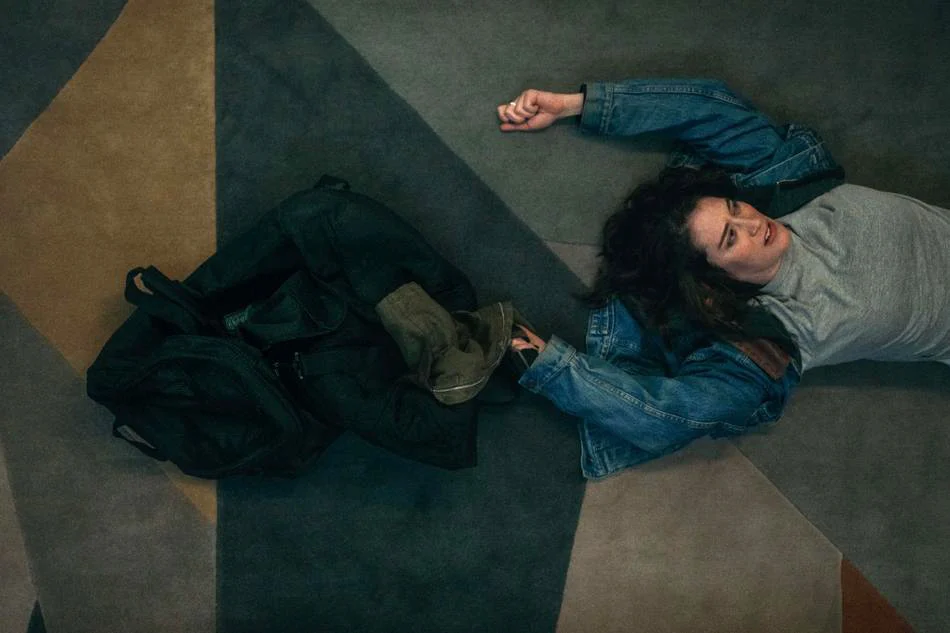
In stark contrast to these overt comedic elements, Patrick Stump’s original score adopts a consistently straight-suspense approach. This deliberate choice serves to ground the film’s darker aspects, preventing the narrative from veering too far into pure farce. Stump’s compositions skillfully build tension and amplify the sense of dread, ensuring that the audience remains keenly aware of the characters’ precarious situation. Cinematographer Ben Goodman expertly straddles the line between the film’s comedic and suspenseful registers with sharp lensing. His use of particular emphasis on overhead shots is not merely an aesthetic choice; it powerfully underlines Caplan’s horizontal helplessness, literally showcasing her vulnerability and the crushing weight of her predicament. The production design by Neil Patel is another standout element, meticulously outfitting Chez Stamos with a wealth of eye-catching decor details. Not least among these are the abstract female portraits attributed to the malevolent “Man,” but which were in fact artfully daubed by co-director Greg Yagolnitzer himself. These paintings serve as silent, unsettling witnesses to the unfolding horror, hinting at the villain’s dark predilections and the fate of previous victims, enriching the film’s visual storytelling and adding layers of macabre artistry.
Ultimately, “Drag” is a film that dares to push boundaries, and its denouement may prove to be a point of contention for some viewers, who might find its conclusion a tad more cruel than strictly necessary. Yet, this particular narrative choice is undeniably a testament to the film’s unwavering commitment to its audacious vision. This modest yet remarkably resourceful exercise in gallows humor cannot be faulted for its steadfast refusal to pull any punches, for sticking firmly to its guns and delivering an ending that aligns with its darkly comedic and morally ambiguous tone. It’s a testament to the filmmakers’ confidence in their distinctive voice and their willingness to embrace the uncomfortable, leaving a lasting impression on those who appreciate a narrative that isn’t afraid to confront the grittier, more unsettling aspects of human nature and survival. “Drag” emerges as a standout debut, proving that compelling storytelling can thrive even within the most unexpected of premises, offering a fresh, albeit unsettling, perspective on sisterhood under duress and the unpredictable nature of peril.