


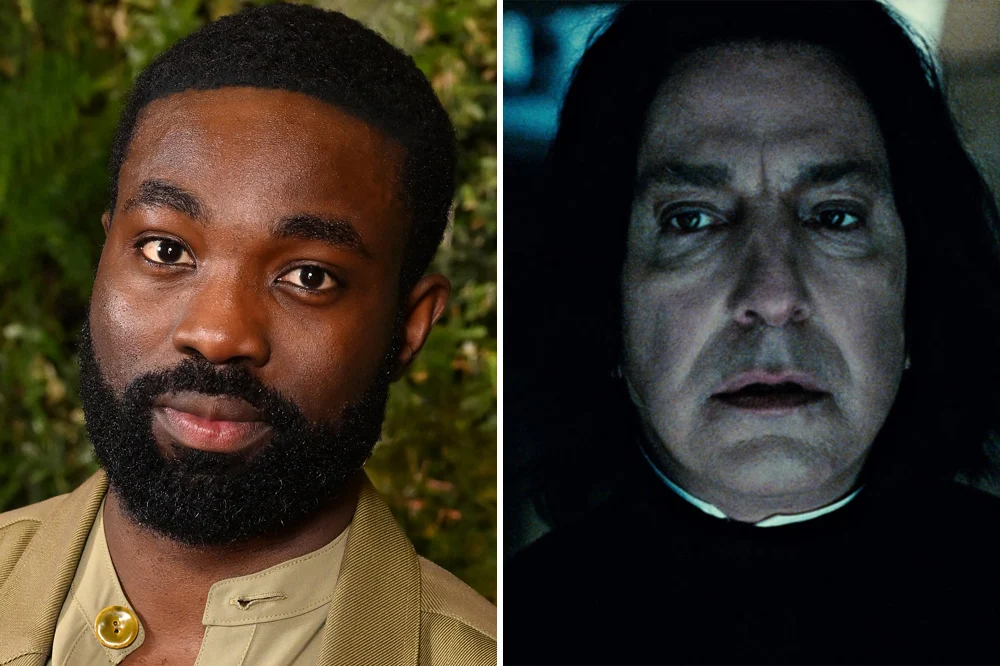
The hallowed halls of Hogwarts are set to welcome a new generation, but the journey to its grand reopening has been marred by a sinister undercurrent of online vitriol. Acclaimed actor Paapa Essiedu, cast as the enigmatic Professor Severus Snape in the highly anticipated HBO Max adaptation of J.K. Rowling’s ‘Harry Potter’ series, has revealed he is receiving race-fueled death threats, a stark reminder of the dark side of passionate fandom. Essiedu’s courageous stance against this hatred, coupled with his commitment to bringing a fresh, inclusive vision to the beloved character, highlights both the challenges and the profound importance of diverse representation in modern storytelling.
In a candid interview with The Sunday Times of London, Essiedu laid bare the disturbing reality of his experience. “I’ve been told, ‘Quit or I’ll murder you,’” he recounted, detailing the chilling messages he’s encountered. The threats aren’t merely abstract; they carry a visceral, personal weight. “The reality is that if I look at Instagram I will see somebody saying, ‘I’m going to come to your house and kill you.’” While acknowledging a degree of self-preservation – “while I’m pretty sure I’m not going to be murdered… That could age badly! But, yes, while I hope I’ll be OK” – the emotional toll is undeniable. Essiedu articulated the fundamental injustice: “nobody should have to encounter this for doing their job.” He drew a poignant contrast between his profession and others facing genuine physical danger: “Many people put their lives on the line in their work. I’m playing a wizard in ‘Harry Potter.’ And I’d be lying if I said it doesn’t affect me emotionally.” His words resonate with a chilling truth, exposing how online harassment, even when seemingly removed from physical harm, can inflict profound psychological damage and disrupt an individual’s sense of safety and well-being.
Essiedu steps into the formidable robes of Severus Snape, the Potions Master and Head of Slytherin House, a character whose complex motivations and tragic backstory have captivated millions. Originally brought to life with iconic gravitas by the late Alan Rickman in the film franchise, Snape is a figure of immense significance within the Wizarding World. His sardonic wit, unrequited love, and ultimate sacrifice make him one of the most debated and deeply cherished characters in literary history. The decision to cast Essiedu, a Black actor, in a role previously depicted as white, ignited a firestorm among a segment of the fanbase, revealing a deeply uncomfortable truth about exclusionary attitudes within what is often perceived as a universally loved fantasy world. This backlash, often cloaked in arguments about “canonical accuracy,” frequently serves as a thinly veiled cover for racial prejudice, exposing an alarming resistance to expanding the visual representation of beloved fictional universes.
The phenomenon of “toxic fandom” is not new, nor is it exclusive to the ‘Harry Potter’ universe. Across various major franchises – from the outcry over diverse casting in ‘The Little Mermaid’ and ‘Lord of the Rings: The Rings of Power’ to the sustained harassment faced by actors in ‘Star Wars’ – a pattern emerges. When creators strive for more inclusive casting, reflecting the diversity of the real world, a vocal minority often reacts with hostility, sometimes escalating to threats and abuse. This behavior is rooted in a sense of ownership over fictional narratives and characters, where any deviation from a perceived “original” or “ideal” portrayal is met with aggressive resistance. For these fans, their personal connection to a story morphs into an entitlement that overrides artistic interpretation, creative evolution, and the fundamental right of actors to embody roles without fear of racialized attacks. The internet provides both anonymity and amplification, allowing these toxic elements to coalesce and target individuals with unprecedented ease and intensity, turning what should be a celebratory announcement into a crucible of hate.
Despite the harrowing nature of the threats, Essiedu finds a powerful wellspring of motivation. “But the abuse fuels me,” he declared, a testament to his formidable resilience and unwavering artistic purpose. “And makes me more passionate about making this character my own.” This defiance is not born of stubbornness but from a profound understanding of what this casting means beyond the immediate controversy. Essiedu articulates a vision rooted in empathy and representation, recalling his own childhood experiences. “I think of how I felt as a kid. I would imagine myself at Hogwarts on broomsticks, and the idea that a kid like me can see themselves represented in that world? That’s motivation to not be intimidated by someone saying they’d rather I died instead of doing work I’m going to be really proud of.” This statement cuts to the heart of why diverse casting matters: it offers a mirror to countless children who have historically been excluded from mainstream fantasy narratives, allowing them to envision themselves as heroes, villains, and complex figures in worlds of magic and wonder. It transforms a global phenomenon into a truly universal one, breaking down barriers of imagination that were perhaps inadvertently erected by previous iterations.
Essiedu’s personal connection to the Wizarding World provides further context to his commitment. Interestingly, despite his new role, he admitted to never having seen the original ‘Harry Potter’ films. However, he was an ardent admirer of J.K. Rowling’s book series during his formative years. “I was an avid reader as a kid,” he shared. “My mum couldn’t afford a babysitter in the holidays, so she would take me to the library. I loved ‘Harry Potter.’ I never saw the films but the books were escapism when other things were less easy for me.” This revelation adds a poignant layer to his current struggle. The very stories that offered him solace and an escape from life’s difficulties are now, paradoxically, the source of immense pressure and racialized hostility. His journey from a child finding refuge in the pages of ‘Harry Potter’ to an actor bravely stepping into one of its most iconic roles, despite the venomous backlash, underscores a powerful narrative of reclaiming and redefining spaces for future generations.
The HBO Max series is poised to embark on a multi-season journey, aiming to faithfully adapt each of Rowling’s seven books, promising a deeper dive into the intricate lore and character development than was possible in the original film saga. Slated for a 2027 launch, the ambitious project has meticulously assembled an (almost) entirely new cast to breathe fresh life into the beloved characters. Alongside Essiedu, the central trio will be portrayed by Dominic McLaughlin as Harry Potter, Arabella Stanton as Hermione Granger, and Alastair Stout as Ron Weasley. This comprehensive recasting signals a deliberate effort to create a distinct identity for the series, separate from the iconic performances that preceded it, while also embracing the opportunity for contemporary relevance and broader inclusivity.
Essiedu’s commitment to this ambitious endeavor is profound. He has signed on for a staggering ten-year tenure, a “big commitment” by any measure. The actor reflected on the significant personal transformation he anticipates: “I’ll be 45 by the time I finish,” he mused, acknowledging the profound impact this decade-long role will have on his life. “and I know my life is going to change in a big way, but I have to just surrender to that. I could have children by the end of this.” This long-term dedication, made in the face of such unwarranted hostility, speaks volumes about Essiedu’s passion for the craft and his belief in the project’s ultimate value. It underscores the immense personal investment actors make in their roles, particularly when they become a part of cultural touchstones, and the courage required to see such a monumental undertaking through, even when met with the darkest corners of online negativity.
Paapa Essiedu’s experience serves as a stark reminder that even in worlds of magic and fantasy, real-world prejudices can cast long, ugly shadows. His unwavering resolve, however, offers a beacon of hope and a powerful testament to the importance of artistic integrity and the transformative power of representation. By standing firm against the tide of hate, Essiedu is not just playing a wizard; he is championing a future where every child, regardless of their background, can see themselves reflected in the stories that shape their dreams and imaginations, ensuring that the magic of Hogwarts truly belongs to everyone.