
A Legacy Forged in Blood and Prophecy: “Outlander” Season 8 Unleashes Its Final, Gut-Wrenching Chapter
SPOILER ALERT: This comprehensive analysis delves into significant plot points from “Soul of a Rebel,” the Season 8 premiere of “Outlander,” now streaming on Starz. Proceed with caution if you have not yet watched.
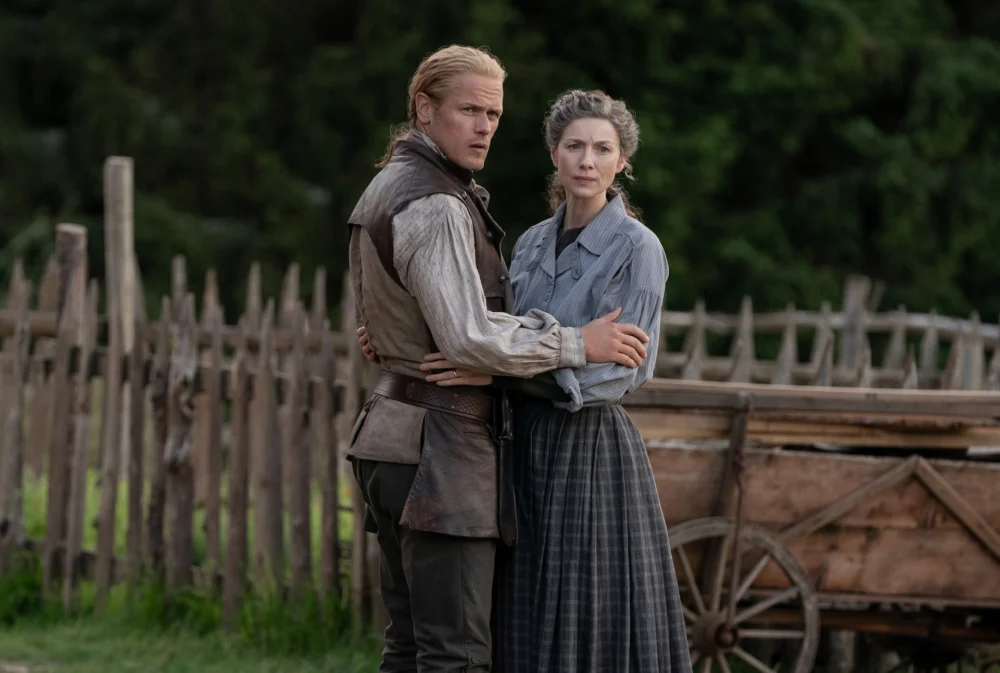
The epic saga of Claire and Jamie Fraser, a love story spanning centuries and continents, embarks on its poignant final journey with the Season 8 premiere of Starz’s global phenomenon, “Outlander.” From its very opening moments, “Soul of a Rebel” wastes no time in asserting the high stakes and emotional intensity that will define this concluding chapter. Less than five minutes into the highly anticipated return, the beloved protagonists, Claire (Caitriona Balfe) and Jamie (Sam Heughan), are thrust into a confrontation that not only reveals a horrifying truth but also forces Claire to cross a moral line she once swore to uphold, setting a chilling precedent for the trials yet to come.
For years, fans of Diana Gabaldon’s bestselling novels and the television adaptation have followed the tumultuous lives of the Frasers, a couple whose love transcends time itself, tested by war, separation, and unimaginable loss. Among their deepest sorrows was the tragic stillbirth of their first daughter, Faith, in Season 2, a moment that left an indelible scar on both Claire and Jamie. Yet, in a stunning revelation last season—a significant departure from Gabaldon’s original narrative that both thrilled and divided the loyal fanbase—it was unveiled that Faith had, in fact, lived. The intervening months between seasons brought further heartbreaking details: Faith grew up in France, a woman unknown to her parents, and bore two daughters of her own. This retconned narrative thread culminates in the Season 8 premiere with a brutal and definitive resolution.
The episode’s chilling opening scene finds Jamie and Claire employing a cunning trap, luring a notorious smuggler named Vasquez (Miguel Álvarez) into their clutches. Their objective: to extract the full, unvarnished truth about Faith’s life and, more pressingly, her untimely demise. The smuggler’s confession is a cascade of horrors, each word a dagger to the hearts of the Frasers and the audience. Vasquez reveals he boarded Faith’s vessel, murdering her husband. When Faith, in a desperate act of maternal defense, bravely attacked him for raping her eldest daughter, Jane, he brutally retaliated, throwing her overboard to her death. The depravity did not end there; Vasquez then sold Faith’s two young daughters, Jane and Fanny (Florrie May Wilkinson), into the hellish life of a brothel. It was in this grim setting that Jamie’s son, William Ransom (Charles Vandervaart), unknowingly encountered them last season. After Jane’s subsequent suicide, the Frasers, moved by compassion and a dawning sense of familial connection, took young Fanny under their protection. The full, devastating truth solidified when Fanny, a child from the 18th century, sang a 20th-century lullaby – a song Claire had sung to the daughter she believed lost so many years ago, a ghostly echo across time confirming their blood relation.

Popular on Variety
The raw, visceral impact of Vasquez’s confession is immediate and profound. Hearing the cold, detailed account of their daughter’s murder and the heinous assault and trafficking of their granddaughters shatters Claire’s composure, stripping away layers of her disciplined medical persona. In a shocking, instinctual act of righteous fury and profound grief, Claire seizes a knife and plunges it into Vasquez’s back. Before the iconic opening credits, now hauntingly sung by Scottish legend Annie Lennox, the healer, Dr. Claire Fraser, has taken a life. This pivotal moment is not merely an act of violence; it is a profound exploration of a mother’s pain and the breaking point of a woman who has endured countless traumas.

Caitriona Balfe, reflecting on her character’s drastic action, offered a wry observation to Variety: “Forgetting all about her Hippocratic oath, obviously!” Yet, the actress, who has embodied Claire for over a decade, quickly delved into the complex emotional landscape that precipitated such a violent outburst. “That action comes out of a deep pain,” Balfe explained. “Hearing somebody talk about your loved ones like that — I don’t think you can ever justify that kind of violence, but I can understand where it came from. I think maybe Claire is more ruthless this season. Maybe.” Claire Fraser has always been a woman of science and compassion, but her journey through two world wars, time travel, and countless personal tragedies has also forged an iron will and a fierce protective instinct. The revelation about Faith, a narrative twist not found in Diana Gabaldon’s original books, has undeniably had unforeseen repercussions, pushing Claire to a moral precipice.
Showrunner and executive producer Matthew B. Roberts offers a compelling counter-argument, suggesting that Claire’s act, while brutal, paradoxically aligns with her core principles. “You can rationalize it, because what this guy is telling Jamie is that he’s going to keep doing harm,” Roberts articulated. “There’s going to be more harm coming to a lot more innocent people, so in a way, I think she kept her oath by protecting those people from him.” This perspective highlights the brutal pragmatism sometimes required in the unforgiving 18th century, where justice often had to be swift and self-administered. It underscores that for Claire, the oath extends beyond individual patient care to a broader duty to protect the innocent from systematic evil.
“Outlander,” which first premiered in August 2014, carries the immense weight of delivering a satisfying conclusion to its devoted global audience. The final season must skillfully tie together a decade’s worth of intricate storylines, character arcs, and historical events, all while navigating the delicate balance between loyalty to Gabaldon’s source material and the creative demands of television adaptation. The decision to open Season 8 with such a shocking, bloody confrontation—a direct consequence of the show’s previous deviation regarding Faith’s fate—serves as a declarative statement. It signals that this final chapter will not backtrack on the show’s established narrative choices, regardless of fan debate. Instead, it commits fully to the unique path it has forged, promising a conclusion that is both bold and emotionally resonant.

Roberts elaborated on the deliberate choice to commence the season with such a visceral act. “We definitely wanted to show how much it meant, and the loss that they’ve gone through, and the pain that they’ve gone through,” he explained, referring to the Frasers’ prolonged journey of discovery and grief regarding Faith. Claire’s immediate, almost primal response, even before Jamie, powerfully conveys “how much pain she’s carried over the years” from the initial loss of her child. “It was important to start this season off like this to show this is not going to be easy,” Roberts concluded, emphasizing the enduring theme of the series: “We’re never worried about Jamie and Claire being together, but the world rips at them in so many different ways, and they endure.” The opening gambit serves as a stark reminder that while their love remains unshakeable, the external forces of history and human depravity will continue to challenge their very existence, pushing them to their limits in the twilight of their epic story.
The world, indeed, continues to rip at them, even as they journey back to what they hope is the sanctuary of Fraser’s Ridge. The community they meticulously built in the wilds of North Carolina as a haven for Scottish immigrants has blossomed during their prolonged absence, a period spent weathering the brutal realities of the American Revolution on its frontlines. Their return is met with a heartfelt welcome from their nephew, Ian (John Bell), who, in a testament to the community’s resilience and loyalty, rallied neighbors to reconstruct the Frasers’ home after it was tragically destroyed by fire. However, the idyllic vision of their thriving settlement is immediately tainted by a palpable whiff of tension emanating from Captain Charles Cunningham (Kieran Bew). Cunningham, a purportedly reformed Loyalist, now commands a powerful trading post, a new economic and social hub, right on Fraser land. His presence, seemingly benign, hints at a subtle shift in the Ridge’s power dynamics, a quiet encroachment on Jamie and Claire’s established authority.
Executive producer Marli Davis observed that in some respects, Fraser’s Ridge has flourished precisely as its founders envisioned. “Despite this presence there that they might not be too pleased with, the fact that it has thrived is what they’ve always hoped,” Davis stated. “Jamie offered this land to people in need, and they’ve been able to make lives there.” The Ridge represents Jamie’s enduring legacy, a testament to his vision of a place where Scots could find peace and prosperity in the New World. Yet, history, and indeed human nature, dictates that success often breeds unforeseen challenges, particularly in the form of power struggles. Jamie, having narrowly escaped death and endured immense personal sacrifice during the recent war, is deeply reluctant to invite further strife back into the heart of his home. However, the premiere subtly, yet ominously, suggests that discord may have already taken root.

Sam Heughan articulated the emerging instability with a poignant observation about Fraser’s Ridge: “These immigrants have come here, and are trying to build a home for themselves. But it’s kind of rotten from the inside a little bit now, or it’s certainly changed at the beginning of the season.” Heughan’s choice of words, “rotten from the inside,” evokes a sense of internal decay, a subversion of the very foundation upon which the Ridge was built. “We don’t know yet what the intentions are of Cunningham and everyone there. But we’ll begin to see that perhaps everything isn’t as stable ground as we thought it was. For them, Fraser’s Ridge might not be a safe place, not a safe home.” This ominous foreshadowing suggests that the threats the Frasers now face are not just external political conflicts, but internal divisions and power plays that could unravel their hard-won peace from within. The notion of their sanctuary becoming unsafe adds another layer of vulnerability to characters who have already sacrificed so much.
Having spent years battling threats on multiple fronts, both military and personal, Claire and Jamie are no longer the relatively young, impetuous individuals they once were. Balfe emphasized this profound shift in their approach to conflict: “Both of them are older now.” She pointed to their recent harrowing experiences, stating, “Especially in that time, they’ve both had near-death experiences not that long ago. I don’t think they have the same well of reserve to say they can fight everything.” The relentless chipping away at their emotional and physical armor has left them exposed. “Every time it sort of chips away at your armor a little bit, and there’s a real vulnerability to them at this point in their lives.” This mature perspective suggests a more cautious, perhaps even weary, approach to the inevitable conflicts that will arise, highlighting their understanding that some battles cannot be won, and others may simply not be worth the cost.
Amidst the burgeoning tensions and lingering grief, a singular bright spot illuminates the premiere: the long-awaited reunion of Claire and Jamie with their daughter, Brianna (Sophie Skelton), her husband, Roger (Richard Rankin), and their two beloved children. Their return from the relative safety of the 20th century, a journey initially undertaken to secure modern medical treatment for their daughter’s heart murmur, carries with it the profound realization that even their own time held its perils, making the 18th century, paradoxically, a safer haven for their family. They arrive bearing gifts that bridge the centuries: a cherished copy of the children’s book “Goodnight Moon,” its vibrant pages a bewildering marvel to young Fanny; a journal detailing medical advancements for Claire, a lifeline to the future of healing; and J.R.R. Tolkien’s epic “The Lord of the Rings” for Jamie, a literary journey for his inquisitive mind. These gifts symbolize not only love but also the blending of worlds, knowledge, and comfort.
However, among these tokens of affection is an object that casts a long, ominous shadow: a book written by Frank Randall (Tobias Menzies), Claire’s first husband, detailing the history of the North Carolina Scots during the American Revolution. As Jamie leafs through its pages, a chilling discovery sends a ripple of dread through the Fraser household: his own name, explicitly mentioned in a passage that prophesies his death at the Battle of Kings Mountain in 1780. This prophetic revelation strikes at the very core of their carefully laid plans to remain clear of the war’s direct path, threatening to pull Jamie back into the maelstrom he so desperately sought to escape. The question looms large: can this foretelling, delivered from the past-future, be trusted, or is it merely a cruel twist of fate, designed to torment them?
Heughan, grappling with the implications of Frank’s book, posed a series of rhetorical questions that cut to the heart of Jamie’s internal conflict: “What are Frank’s intentions? Is this Frank coming back to torment him, or is Frank trying to help him?” For Jamie, whose life has been a relentless succession of brushes with death, often in defense of Claire, the prophecy resonates with a deep-seated acceptance of his own mortality. “Personally, I always felt that when Jamie sees Claire for the first time, he sees his death. He sees someone that he’s going to die for,” Heughan reflected. “There have been multiple times where Jamie’s faced death because of Claire or while he’s with Claire. In some ways, it’s finally happening. He’s always been prepared to die for her and for their family.” This profound intel about his own future, originating from a man who remains a complex and often sore subject for Jamie, is poised to dictate a significant portion of his journey this season, forcing him to confront not only his mortality but also the ghosts of his past.
To truly amplify this raw nerve, the creative team ingeniously brought back Tobias Menzies, not physically, but through his distinct and commanding voice, narrating these haunting passages from Frank’s book. Showrunner Roberts shared the intent behind this choice: “We wanted to bring Tobias back physically, but his schedule is just too busy.” He added, acknowledging Menzies’ willingness to participate, “He was so gracious. He wanted to be a part of it and having his voice actually works because it’s haunting.” The decision to use Menzies’ voice is particularly potent given the additional layer of revelation Jamie faces: the author photo on the book jacket is the first time Jamie sees Frank, and in that image, he sees the uncanny resemblance to his tormentor, Black Jack Randall. This visual and auditory assault intensifies Jamie’s psychological battle. Heughan himself noted the profound impact of this choice, explaining that for Jamie, who has no memory of Frank’s voice, Menzies’ narration transcends a mere literary