


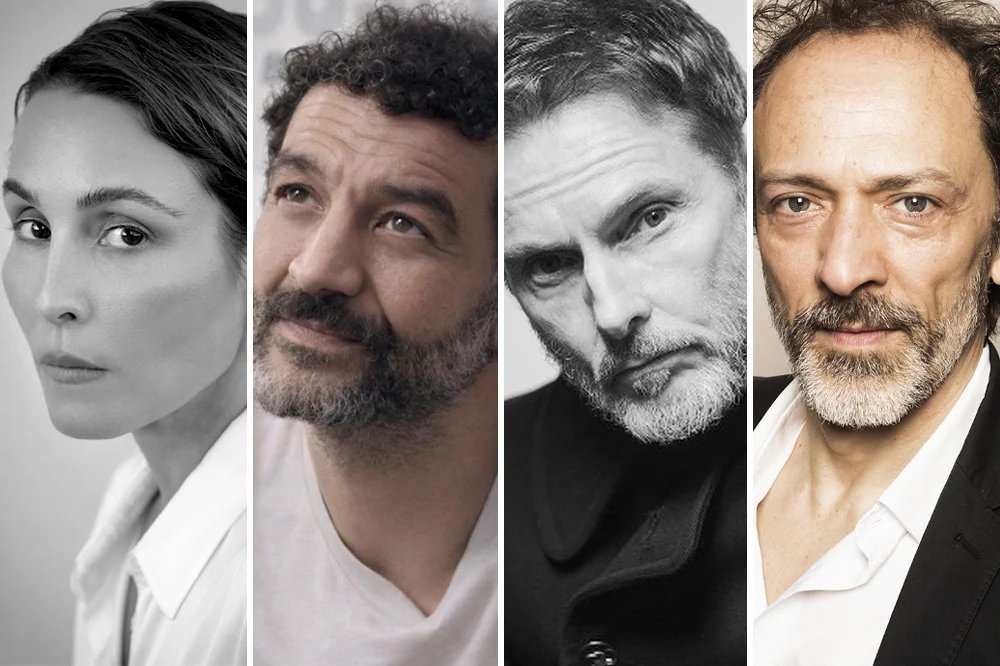
The highly anticipated live-action adaptation of Ubisoft’s global phenomenon, “Assassin’s Creed,” is rapidly taking shape at Netflix, with the streaming giant recently unveiling a significant expansion to its already impressive cast. The addition of acclaimed actress Noomi Rapace, alongside Ramzy Bedia, Sean Harris, and Corrado Invernizzi, signals Netflix’s deep commitment to crafting a series that lives up to the grand legacy of its source material, promising an intricate tapestry of historical intrigue and high-stakes action.
Noomi Rapace, an actress renowned for her intense performances and ability to embody complex, resilient characters, stands out among the new recruits. Her filmography speaks volumes about her suitability for the “Assassin’s Creed” universe, a world brimming with shadowy conspiracies, moral ambiguities, and characters often forced to make impossible choices. Rapace first captivated international audiences with her portrayal of Lisbeth Salander in the original Swedish “The Girl with the Dragon Tattoo” trilogy, a role that showcased her capacity for fierce independence, vulnerability, and a dark edge. She further cemented her status as a formidable presence in sci-fi epics like Ridley Scott’s “Prometheus,” where she anchored the narrative with a blend of intellectual curiosity and raw survival instinct. More recently, her turn in the Icelandic folk horror “Lamb” demonstrated her range, proving she can navigate narratives steeped in the surreal and the deeply human. Her recurring role in “Assassin’s Creed,” though undisclosed, immediately elevates the series’ dramatic potential, suggesting a character of considerable depth and impact, a perfect fit for a franchise celebrated for its strong, enigmatic female figures throughout history.
Joining Rapace are a trio of equally compelling talents. Sean Harris, an actor celebrated for his captivating and often unsettling performances, brings a formidable intensity to any project. Known to global audiences for his chilling portrayals of villains and complex anti-heroes, particularly his role as Solomon Lane in the “Mission: Impossible” franchise and his haunting performance in “The Stranger,” Harris possesses a unique ability to command the screen with understated menace or explosive fervor. His involvement hints at a character who will undoubtedly contribute significantly to the series’ central conflict, whether as an ally or an adversary. Ramzy Bedia, a versatile French actor and comedian, known for his work in projects like “Of Money and Blood” and “Haunted Minds,” brings a different texture to the ensemble. His varied background suggests a potential for characters that might offer unexpected layers, perhaps a blend of wit and gravitas, which is often a hallmark of the “Assassin’s Creed” supporting cast. Rounding out this powerful quartet is Corrado Invernizzi, an Italian actor with a rich resume including appearances in blockbuster hits such as “Indiana Jones and the Dial of Destiny” and “Ford v. Ferrari.” Invernizzi’s extensive experience in diverse international productions ensures a seasoned presence, lending authenticity and weight to the series’ potentially global scope.
These new additions complement an already announced roster of promising talent, including Toby Wallace, Lola Petticrew, Zachary Hart, Laura Marcus, and Tanzyn Crawford. While specific character details for all cast members remain shrouded in mystery, this blend of established stars and rising talents underscores the breadth of the narrative Netflix aims to tell. The collective acting prowess promises a dynamic and engaging ensemble, crucial for a series that intends to traverse complex historical landscapes and deeply personal journeys.
At its core, Netflix’s “Assassin’s Creed” is positioned as a “high-octane thriller centered on the secret war between two shadowy factions – one set on determining mankind’s future through control and manipulation, while the other fights to preserve free will.” This official logline perfectly encapsulates the philosophical battle that has defined the franchise for over a decade and a half. The series is set to follow its characters across “pivotal historical events as they battle to shape humanity’s destiny,” a promise that thrills fans of the games’ signature blend of meticulously researched history and fantastical science fiction.
The “Assassin’s Creed” video game franchise itself is a cultural juggernaut, having sold over 230 million units globally since its debut in 2007. Comprising 14 main installments and numerous spin-offs, the games have carved out a unique niche by intertwining historical accuracy with a compelling meta-narrative. The central conflict pits the ancient Order of Assassins, champions of free will and individual liberty, against the Templar Order, who believe true peace can only be achieved through absolute control and order. This ideological struggle plays out across millennia, with modern-day protagonists using an advanced machine called the Animus to access the genetic memories of their Assassin ancestors. Through these virtual historical excursions, players (and soon, viewers) are immersed in pivotal moments from human history – from the Crusades and the Renaissance to the Golden Age of Piracy and the French Revolution, all while hunting for powerful artifacts known as Pieces of Eden, relics of a technologically advanced precursor civilization that hold immense power to shape human destiny.
The enduring appeal of “Assassin’s Creed” lies in its ability to transport players to meticulously recreated historical settings, allowing them to interact with iconic figures and witness world-changing events through a unique lens. Beyond the thrilling parkour, stealth, and combat mechanics, the games delve into profound philosophical questions about power, morality, sacrifice, and the very nature of human freedom. This rich tapestry of lore, combined with stunning visual design and compelling narratives, offers a wealth of material for a long-form television series, a format far better suited to exploring the sprawling timeline and intricate character arcs than a single feature film.
Indeed, the memory of the 2016 “Assassin’s Creed” film, starring Michael Fassbender, serves as a poignant reminder of the challenges in adapting such a complex IP. While visually ambitious, the film struggled to condense the expansive lore and character development into a two-hour runtime, leaving many fans and critics underwhelmed. Netflix’s decision to pursue a series format, with the backing of Ubisoft’s dedicated film and television division, signifies a strategic understanding of what it takes to do justice to the franchise. The longer runtime inherent in a series allows for a deeper dive into character motivations, a more nuanced exploration of the Assassin-Templar conflict, and the opportunity to truly breathe life into the diverse historical periods the games so masterfully portray.
Helming this ambitious endeavor are executive producers and showrunners Robert Patino and David Wiener. Patino, known for his work on thought-provoking series like “DMZ” and “Westworld,” brings a proven track record in crafting narratives that blend complex themes with high-concept sci-fi elements. Wiener, whose credits include the critically acclaimed “Halo” and the psychological thriller “Homecoming,” demonstrates an expertise in building immersive worlds and maintaining tension over extended story arcs. Their combined experience suggests a series that will be both intellectually stimulating and viscerally thrilling, a balance essential for “Assassin’s Creed.”
Further bolstering the production team are executive producers Gerard Guillemot, Margaret Boykin, Austin Dill, and Genevieve Jones representing Ubisoft Film & Television, alongside Matt O’Toole. Ubisoft’s direct involvement is a crucial element, providing an invaluable layer of authenticity and ensuring that the series remains true to the spirit and lore of the games. This collaborative approach between the creative visionaries at Netflix and the custodians of the “Assassin’s Creed” universe at Ubisoft bodes well for a faithful yet innovative adaptation.
For a professional women-focused news and entertainment website, the “Assassin’s Creed” series holds particular appeal. The franchise, especially in recent installments, has increasingly featured strong, multifaceted female protagonists who are not only capable warriors but also complex leaders and thinkers. Characters like Evie Frye in “Assassin’s Creed Syndicate,” Kassandra in “Assassin’s Creed Odyssey,” and Aveline de Grandpré in “Assassin’s Creed III: Liberation” have resonated deeply with players, showcasing intelligence, resilience, and moral fortitude. Noomi Rapace’s casting further strengthens the expectation that the Netflix series will continue this tradition, offering compelling female characters at the forefront of its narrative. The exploration of historical periods, from ancient Greece to Victorian London, also provides a fascinating backdrop for examining societal roles and challenges faced by women throughout history, albeit through a fantastical lens. The themes of free will versus control, and the fight against oppression, are universal and deeply resonant, appealing to an audience that appreciates stories with substance and a sense of justice.
As production ramps up, the excitement for Netflix’s “Assassin’s Creed” continues to build. With a stellar cast led by the formidable Noomi Rapace, a seasoned creative team, and the direct involvement of Ubisoft, the series is poised to deliver an epic, high-stakes narrative that promises to captivate both loyal fans of the games and a new generation of viewers. The intricate dance between historical authenticity and speculative fiction, coupled with a deep dive into humanity’s enduring struggle for freedom, positions this adaptation as one of the most eagerly anticipated television events on the horizon, ready to usher audiences into a world where everything is permitted.