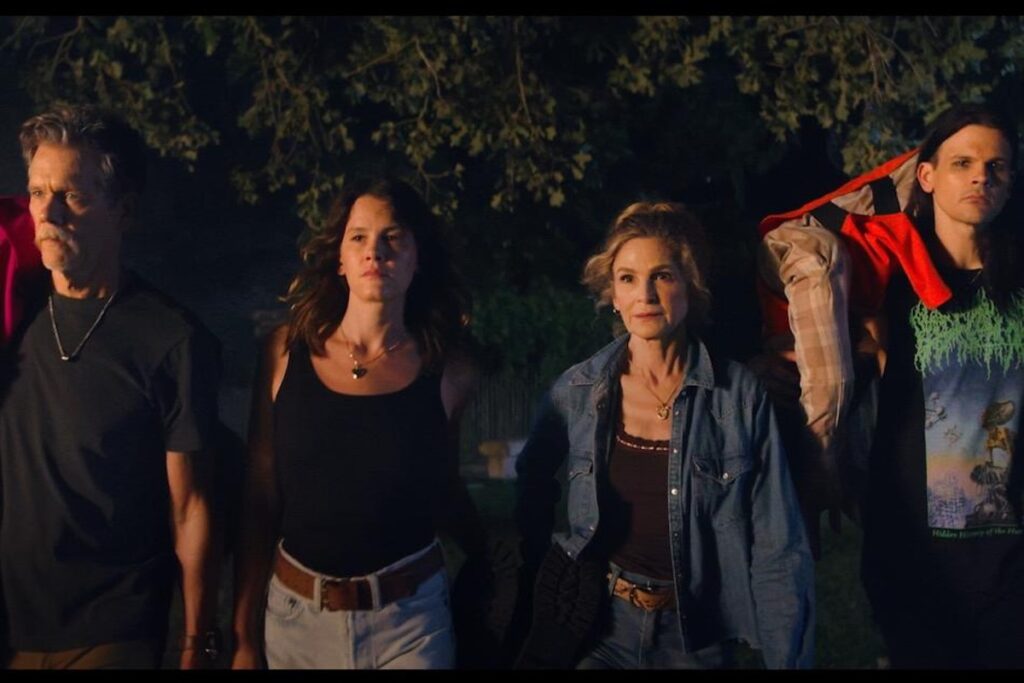




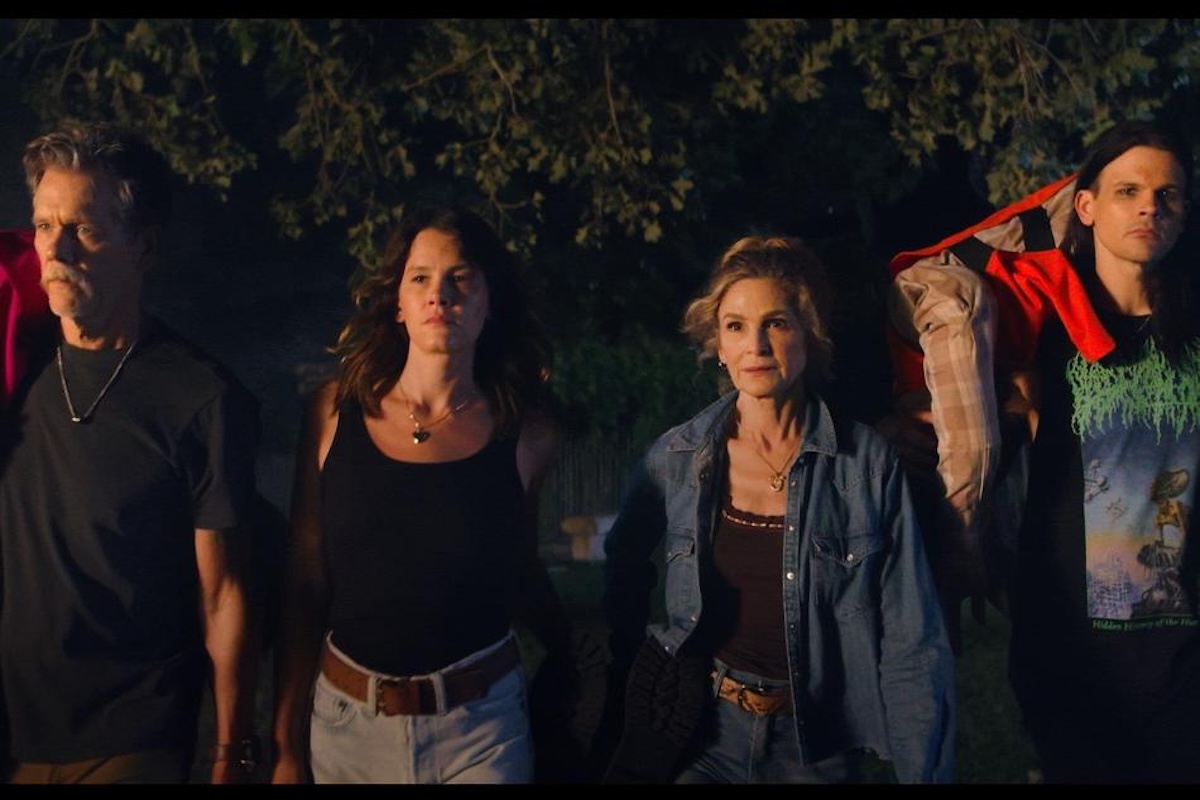
The line between life and art often blurs in the entertainment industry, but rarely with such gleeful abandon and bloody consequences as in the new horror-comedy, Family Movie. This meta-cinematic romp, featuring real-life power couple Kevin Bacon and Kyra Sedgwick alongside their children, Sosie and Travis Bacon, dives headfirst into the chaotic world of low-budget filmmaking, familial dynamics, and a burgeoning body count. Far from a straightforward slasher, the film offers a surprisingly sharp, if outrageously gory, dissection of the compromises, ambitions, and dark undercurrents that can define a family deeply entrenched in the fickle world of show business.
At its heart, Family Movie is a send-up of the scrappy, no-holds-barred independent film productions that often exist on the fringes of Hollywood glamour. Kevin Bacon takes on the role of Jack Smith, a B-movie director whose artistic aspirations far outstrip his budget or perhaps even his talent. Jack’s latest opus, a horror flick titled Blood Moon, is being shot on a remote Texas farm, and the air is thick with the scent of ambition, desperation, and, soon enough, fresh blood. For an audience accustomed to seeing Bacon in more polished productions, his portrayal of Jack is a delightful dive into a character teetering on the edge of creative madness and financial ruin, constantly battling dwindling daylight, a demanding financier, and the subtle, often unspoken, resentments of his own family serving as his cast and crew.
The film immediately disabuses any notion that this family affair will be a heartwarming, indulgent vanity project. Instead, director Dan Beers, working from his own script, crafts a narrative that is crude and visceral in its execution, mirroring the very B-movie aesthetic Jack Smith champions. The editing is brusque, almost reckless, perfectly aligning with the rapid-fire succession of brutal, comedic kills that define the film’s horror elements. Yet, beneath this rough-hewn exterior lies a surprising layer of sophistication. Family Movie quickly pivots from easy jokes about the perils of a shoestring budget to more profound, and often uncomfortable, truths about the intricate web of relationships within a showbiz family. The film explores how personal sacrifices, long-held dreams, and the desperate pursuit of success can warp familial bonds, especially when a real killer begins to stalk the set.
One of the most instantly ingratiating aspects of the film is its portrayal of the Smith family’s hands-on approach to their collective creative endeavor. We witness Helen (Kyra Sedgwick) and her daughter Ula (Sosie Bacon) serving sandwiches to the crew after a particularly demanding scene. This seemingly mundane act speaks volumes about the blurred lines between personal and professional life on such a set. Everyone is pitching in, a testament to the family’s shared commitment, yet the atmosphere is anything but harmonious. Jack is constantly agitated, particularly by Maya (Liza Koshy), a BTS videographer whose father’s financial backing makes her an indispensable, albeit irritating, presence. His musician son, Trent (Travis Bacon), also yearns for a more active role behind the camera, a desire that clashes with his father’s fixed vision and his own uncertain professional trajectory.
Sosie Bacon’s Ula finds herself at a critical juncture, navigating the bittersweet complexities of a burgeoning career. While grappling with the patchy cell service deep in the heart of Texas, Ula receives news from her manager, Catherine (Andrea Savage), that she has landed a coveted lead role in a new TV series. This is the "good kind" of career problem, a significant professional breakthrough, but it presents a profound personal dilemma: accepting the role means bailing on her parents’ film before production wraps. This conflict resonates deeply, particularly for women who often face unique pressures to balance personal loyalty with professional ambition. Ula’s struggle is a poignant exploration of the generational shifts in the industry and the difficult choices young artists must make to forge their own paths, sometimes at the expense of family expectations.
The narrative takes a darkly comedic turn when Jack, already burdened by mounting debt and the relentless ticking clock of daylight, stumbles upon a shocking discovery: his wife, Helen, has murdered their noisy, lecherous neighbor, Bill (John Carroll Lynch). Helen’s reasoning is brutally pragmatic – Bill’s barking dog was ruining takes, and his inappropriate advances were simply too much. What might have been a moment of horror quickly transforms into the driving force of the film’s twisted comedy. Jack, ever the pragmatist focused on his film, is surprisingly unbothered by the revelation. However, the arrival of a local sheriff (Scoot McNairy) quickly escalates the situation, and the family begins to suspect that Bill’s murder might not have been an isolated incident, sending them spiraling into a cover-up that only serves to highlight their dysfunctional dynamics.
Kyra Sedgwick’s portrayal of Helen is arguably the film’s most captivating and subversive performance, offering a juicy role that allows her to shine. Helen, initially presented as the supportive, somewhat overlooked matriarch, transforms into a gleefully unhinged domestic goddess who finds immense satisfaction in slicing through more than just bread for craft services. Her character embodies a fascinating exploration of suppressed desires and the explosive potential of a woman who has seemingly sacrificed her own promising acting career to support her husband’s often-dubious artistic endeavors and raise their children. This backstory adds an intriguing layer to Ula’s dilemma, as she grapples with the prospect of breaking away from a path her mother might have once envisioned for herself. Helen’s transformation is a potent, albeit darkly humorous, commentary on the hidden resentments and untapped potential that can fester beneath the surface of seemingly conventional roles, particularly for women in the shadow of more famous male partners.
Dan Beers’ script, while embracing the film’s comedic and gory sensibilities, never shies away from doing the necessary dramatic legwork to ground the family’s issues. The exploration of Helen’s sacrificed career, a common narrative for many women in Hollywood who prioritize family or a partner’s career, adds a layer of depth to her character’s extreme actions. It makes her gleeful embrace of violence a bizarre, yet understandable, release from years of quiet subservience. Similarly, Trent’s struggle to communicate openly with his father and find his own voice within the family’s creative sphere is subtly handled. While perhaps the least developed of the main characters, Travis Bacon’s authentic presence, with his long hair and general air of indifference to the film-within-a-film, speaks volumes. His contribution to the film’s heavy metal soundtrack with his band Contracult is a clever nod to his real-life musical talents, weaving another thread of authenticity into the meta-narrative.
Family Movie is a testament to the idea that intentional clumsiness can sometimes be a virtue. The filmmakers clearly embrace a slapdash aesthetic, whether it’s the abrupt introduction of Helen’s murderous tendencies or a slightly tacked-on opening involving a film critic who has been a persistent thorn in Jack’s side. These choices, rather than detracting from the experience, enhance the film’s meta-commentary on low-budget horror filmmaking. Not every viewer will appreciate a chaotic dance number jarringly spliced into a gruesome sequence involving a woodchipper, but for the right audience, these moments play like gangbusters. They create a unique, anarchic energy that suggests the film hasn’t just brought a family together on screen, but has fostered a sense of shared, joyful madness among its creators and its appreciative audience.
The film’s concluding moments further cement its unique blend of heart and horror. It’s not every slasher film that accompanies its credits with personal home movies from the filmmakers’ school plays and concerts. This unexpected touch of sweetness, a reminder of genuine family memories, feels perfectly in line with the film’s spirit. Knowing that the copious amounts of fake blood spilled throughout the movie are made from corn syrup, the underlying "sweetness" of this unconventional family project doesn’t feel out of place. It’s a powerful metaphor for the film itself: a thick, syrupy concoction of genre tropes, dark humor, and genuine familial affection, all blended into a memorable cinematic experience. Family Movie ultimately celebrates the messy, often hilarious, and sometimes terrifying reality of making art with the people you love, proving that even amidst chaos and gore, there’s always room for a little bit of family magic.