



Salt-Stained Souls: The Deep Currents of Life in Bucks Harbor, Maine
‘Bucks Harbor’ Review: A Wistful, Humane Portrait of Hardy Souls, Young and Old, in Coastal Maine
The rugged, unforgiving coastline of Bucks Harbor, Maine, a landscape sculpted by aeons of crashing waves and biting winds, serves as more than just a backdrop for Pete Muller’s poignant documentary. It is a character in itself, mirroring the indelible marks left on the faces and lives of the men who call this remote fishing village home. In “Bucks Harbor,” Muller, a seasoned photographer making a fluent and expansive transition into documentary filmmaking, masterfully employs his keen eye to capture the profound narratives etched into these visibly storied visages. His camera doesn’t merely observe the weary, callused hands and weathered expressions of the community’s fishermen; it gazes with an empathy that transcends simple observation, revealing full-bodied characters with intricate tales that unfold against a backdrop of ceaseless tides and relentless weather.
Muller’s photographic roots are evident in every frame, lending the film an almost painterly quality, each shot composed with a sensitivity that elevates the mundane rhythms of daily life into something deeply profound. He approaches his subjects not as anthropological curiosities or rural ethnographic case studies, but as individuals whose lives, though seemingly ordinary, pulse with an extraordinary resilience and a quiet dignity. This deeply humanistic approach imbues “Bucks Harbor” with a warmth that gently overrides the inherent melancholy of its material, transforming what could have been a bleak portrayal of hardship into an unsentimental yet profoundly moving crowd-pleaser. The film’s empathetic interest in individual, often eccentric human lives struck a chord with audiences globally, earning it a runner-up spot in the Panorama section’s audience awards following its world premiere in Berlin. Its North American debut at the True/False fest has undoubtedly set the stage for a lengthy and well-deserved run across numerous documentary festivals, signaling its arrival as a significant voice in contemporary non-fiction cinema. For distributors, especially those with a keen eye for compelling human-interest stories, “Bucks Harbor” presents a unique opportunity, promising engaging viewing on streaming platforms while simultaneously begging for the immersive experience of theatrical exhibition, where its textured, wind-whipped sense of place can truly envelop the viewer.
Bucks Harbor is not a place one stumbles upon accidentally. Its remoteness is a defining characteristic, articulated with a jaded, almost poetic wit by Mike, a stoic lobster trawler and one of the film’s central figures. “If Bangor, Maine is the asshole of the world, we’re 200 miles up it,” he quips, a statement delivered not with bitterness, but with a prevailing mood of resigned contentment. This candid assessment perfectly encapsulates the village’s identity: a sleepy, somewhat dilapidated outpost nestled precariously close to the Canadian border, yet possessing its own unique, shabby comforts. It is a place where the harsh realities of life are softened by the familiar embrace of community and the unspoken understanding that comes from sharing the same struggle against the elements.
The film introduces us to four principal subjects, each a mosaic of the community’s diverse working-class masculinity, challenging simplistic notions and revealing the surprising depths beneath their rugged exteriors. Among them is Dave, a fisherman whose entire life has unfolded within the confines of Bucks Harbor. For Dave, this environment has been both a stifling cage and a saving grace. As a teenager, he harbored a nascent artistic talent, a spark of creativity that, in the isolated confines of his world, ultimately found nowhere to truly ignite. Today, he channels that artistic impulse into drawing for his own amusement, a quiet act of self-expression that coexists with the stark reality of supplementing his modest income with regular visits to a local food bank. Yet, despite the setbacks and the unfulfilled potential, Dave remains remarkably good-humored, grateful simply to be alive and to navigate the complexities of his life with the steadfast support of his mother.
Dave’s mother is a force of nature in her own right, a delightfully salty and fiercely independent woman whose brief but impactful appearances on screen are a testament to the quiet strength that often underpins such communities. She articulates her philosophy on gender roles with a bluntness that is both amusing and insightful: women, she insists, need men “just for babies.” Her son, equally content in his solitude, echoes this sentiment, resisting any notion of a conventional partnership. This dynamic between mother and son offers a fascinating glimpse into the nuanced relationships that thrive in Bucks Harbor, where traditional roles are sometimes subverted by the practicalities of survival and individual preference. Dave, with his drawling humor and generous spirit, emerges as the most outwardly charismatic of the film’s subjects, his personal narrative weaving together threads of past struggles with drug addiction and present resilience, painting a portrait of a man who has wrestled with his demons and found a fragile peace within his familiar world. His story speaks to the universal human capacity for self-reinvention and the enduring power of familial bonds, even when expressed in unconventional ways.
Beyond Dave’s captivating narrative, the film meticulously fleshes out a more surprising overview of local working-class masculinity. Mark, a middle-aged, married man who works in a tackle shop, initially presents as a taciturn, hard-shelled type. His quiet demeanor, however, belies a hidden depth, for over time, Mark has discovered an unexpected outlet for his more expressive impulses. The film subtly hints at this artistic or creative awakening, leaving the specifics to the viewer’s imagination, thereby underscoring the idea that even in the most seemingly stoic individuals, a vibrant inner life can thrive. This revelation challenges preconceived notions of masculinity in a rugged, blue-collar setting, suggesting that self-expression can take many forms beyond the traditionally expected. Mark’s story is a quiet affirmation of the human need for connection and creativity, even when it surfaces in surprising ways.
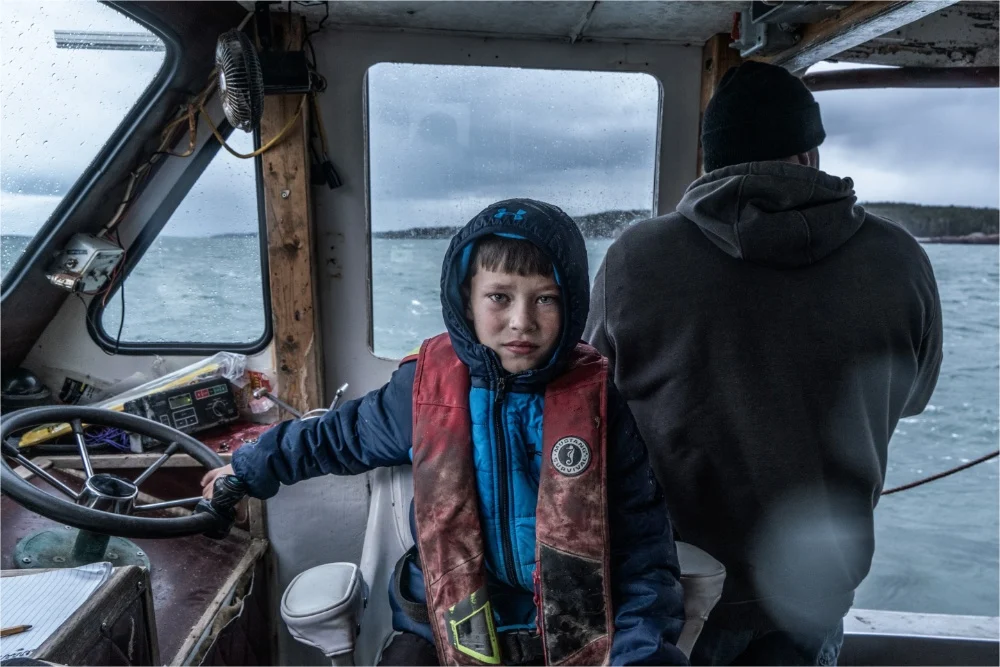
Then there is Mike, the aforementioned lobster trawler, a figure of rugged family tradition. He is raising two sons who already ply the family trade with a “preternaturally toughened” proficiency that is both impressive and deeply poignant. Watching these young boys navigate the stern realities of their father’s boat, their faces already etched with a seriousness beyond their years, evokes a powerful sense of inherited destiny. Their early mastery of the harsh fishing life speaks volumes about the generational transfer of knowledge, the demands of the environment, and the unyielding grip of tradition in Bucks Harbor. It’s a stark reminder of the sacrifices and the fierce pride embedded in a livelihood passed down through bloodlines, a cycle of arduous work that defines their very existence.
Finally, we meet Wayne, a profusely bearded clamdigger whose life has been marked by profound hardship. He reflects on a series of failed marriages and the brutal childhood abuse he suffered at the hands of his father. What is most striking about Wayne’s narrative is his shrugging lack of self-pity, a stoicism born of survival. Yet, beneath this seemingly detached recounting, there is a silent sorrow that radiates from his tired, scarred demeanor. His story is a powerful, understated testament to the enduring scars of trauma and the quiet ways individuals carry immense burdens, often without external complaint. Wayne’s resilience, though tinged with tragedy, speaks to an inner strength forged in the crucible of adversity, a testament to the human spirit’s capacity to endure even the most profound pain.
Muller and editor Noel Paul meticulously craft a film that resists imposing a conventional narrative arc on these fragmented lives. Instead, “Bucks Harbor” adopts a strictly observational approach, casually drifting between its subjects at a pace that mirrors the unhurried, loping rhythm of their daily existence. This deliberate choice extends to a complete absence of onscreen names or contextualizing title cards; the audience is invited to get to know these men organically, in their own good time, fostering a deeper, more intimate connection. This immersive technique allows the viewer to absorb the nuances of their lives, their interactions, and their environment without the intrusion of external explanations, cultivating a sense of genuine discovery.
Occasionally, the film’s focus subtly shifts from the fishermen to their crustacean quarry in the deep. The lobsters, too, are depicted as guarded and unhurried, yet intensely vulnerable within their underwater world. This man-lobster parallel is handled with exquisite delicacy, never stretched to the point of contrivance. Instead, it serves as a thoughtful, holistic lens through which to view all the living inhabitants of the region. The lobsters, like the men who hunt them, are survivors in a harsh ecosystem, their existence intrinsically linked to the powerful forces of nature. This symbolic connection underscores the film’s broader message about the interconnectedness of life in Bucks Harbor, where humans and wildlife alike are shaped by the same powerful, often unforgiving, environment.
“Bucks Harbor” captures the spread of male archetypes within this small community with such perceptive detail that any more direct social commentary becomes unnecessary. The film presents a rich tapestry of masculinity: some men are patriarchally conservative, rooted in traditional roles; others exhibit queerly progressive traits, embracing unconventional paths; and all, in their own unique ways, bear visible wounds. These men are undeniably products of their raw, challenging environment, yet no two are shaped in quite the same way. The film thus transcends simplistic categorizations, offering a nuanced and deeply human exploration of identity and belonging in a place that demands both conformity and fierce individuality. The environment itself, as shot by Muller and his fellow cinematographers Nathan Golon and Mark Unger, is a character of formidable presence. In seasonally shifting shades of storm and stone, with the water a defining force—churning violently, frozen solid, or serenely calm—Bucks Harbor emerges as a compellingly changeable and powerful place, the kind that inherently dictates the terms of existence for its humble residents. It is a world where survival is not just a challenge, but a way of life, and where the human spirit, much like the craggy coast, endures with remarkable tenacity.
The film’s success at major festivals underscores its universal appeal, proving that stories from seemingly small, remote corners of the world can resonate deeply with a global audience. Its ability to be a “crowdpleaser” despite the underlying melancholy lies in its profound empathy and its refusal to sensationalize hardship. Instead, it invites viewers to witness the quiet resilience, the unexpected humor, and the deep humanity that thrives even in the most challenging conditions. For a professional women-focused news and entertainment platform, “Bucks Harbor” offers invaluable insights. While the primary subjects are men, the film powerfully explores themes of human endurance, the impact of environment on identity, and the complex tapestry of relationships – including the fierce independence embodied by Dave’s mother – that define a community. It challenges preconceived notions about working-class men, presenting them not as stereotypes but as complex individuals grappling with their pasts and striving for meaning. This nuanced portrayal of masculinity, alongside the powerful depiction of a resilient community, offers a rich narrative for an audience interested in diverse human experiences, the quiet strength found in unexpected places, and the enduring power of the human spirit to adapt and thrive against all odds. It is a testament to the idea that every life, no matter how remote or seemingly ordinary, holds a profound and compelling story waiting to be told.