



A Legacy Etched in Laughter: Seth Rogen and Evan Goldberg Honor Catherine O’Hara’s Enduring Brilliance
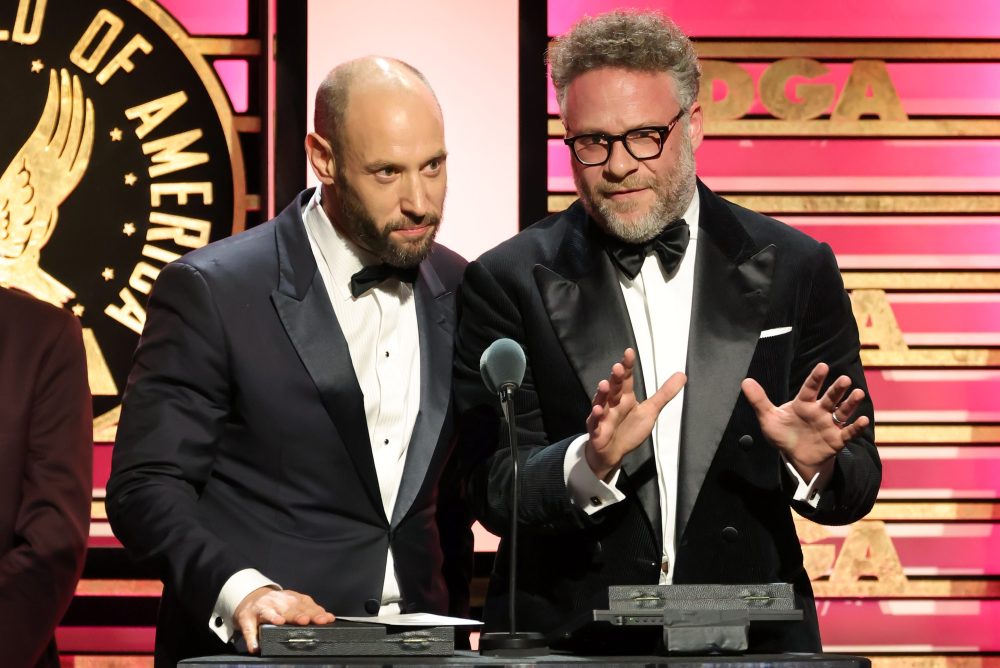
In a poignant and deeply moving moment that transcended the usual pomp of awards season, filmmaking duo Seth Rogen and Evan Goldberg dedicated their latest triumph to the memory of their cherished co-star, Catherine O’Hara. Accepting the coveted best comedy series award for their critically acclaimed Apple TV+ production, “The Studio,” at the Directors Guild Awards on Saturday, Rogen and Goldberg transformed a celebratory occasion into a heartfelt tribute to an artist whose influence stretched across generations and whose recent passing left an indelible void in the entertainment world.
The prestigious event, held at the venerable Beverly Hilton, became a platform for Rogen and Goldberg to reflect on the profound impact O’Hara had not only on their series but on their lives and careers. O’Hara, a comedic titan whose career spanned decades of iconic roles, passed away on January 30th at the age of 71. Her unexpected departure sent ripples of sadness through Hollywood and among legions of fans who had come to adore her unparalleled talent and unique charm. For Rogen and Goldberg, her absence was particularly acute, as she had just graced their audacious satire, “The Studio,” with a performance that garnered her an Emmy nomination for supporting comedy actress in the show’s freshman season. In the series, which unsparingly skewers the often-absurd inner workings of Hollywood, O’Hara embodied the formidable and complex character of Patty Leigh, a high-powered executive whose wit and gravitas were perfectly suited to O’Hara’s masterful delivery.
“The Studio,” a series celebrated for its sharp writing and fearless commentary on the entertainment industry, had already made a significant splash, earning the best comedy title at the Emmy Awards just last September. The DGA win further solidified its standing as a groundbreaking entry in the comedy landscape. Yet, for its creators, the victory felt incomplete without O’Hara’s radiant presence. Her portrayal of Patty Leigh was more than just a role; it was a cornerstone of the show’s success, a testament to her ability to bring depth and nuance to even the most satirical characters. Leigh, a woman navigating the cutthroat world of studio politics with a blend of steely resolve and unexpected vulnerability, was a character that only O’Hara could fully inhabit, infusing her with a humanity that made her both formidable and relatable.
Rogen and Goldberg, known for their distinct brand of humor and their collaborative spirit, spoke with genuine emotion about their long-held admiration for O’Hara. “Our idol since we were children,” Rogen declared, a sentiment echoed by Goldberg. This reverence stemmed from a shared formative experience: their enduring love for the 1990 holiday classic, “Home Alone.” O’Hara’s unforgettable performance as Kate McCallister, the frantic mother who accidentally leaves her son behind, cemented her status as a cultural icon for an entire generation. For young Rogen and Goldberg, “Home Alone” wasn’t just a movie; it was a touchstone, a gateway to understanding the magic of filmmaking and the power of comedic performance. That a childhood hero would later become a pivotal member of their own creative endeavor was, for them, a dream realized, tinged now with profound sorrow.
The duo shared a particularly heartwarming anecdote from the set of “The Studio” that perfectly encapsulated their awe and affection for O’Hara. “Home Alone honestly is like the movie that made me wanna make movies in a lot of ways,” Rogen explained to the star-studded audience. “In that movie she’s always yelling ‘Kevin, Kevin,’ and on set she would always be yelling, ‘Evan, Evan,’ and every time she did it we were like, It’s like ‘Home Alone.’” This seemingly simple interaction, a playful echo of her most famous line, transformed mundane production moments into cherished memories, a constant, delightful reminder of the legend they were working alongside. It underscored the surreal joy of collaborating with someone who had so profoundly shaped their early artistic aspirations, a full-circle moment for two creators who had grown up studying her craft.
Catherine O’Hara’s reputation in Hollywood extended far beyond her on-screen performances. She was universally adored not just for her unparalleled talent but for her inherent kindness, generosity, and unwavering professionalism. Her presence on any set was known to elevate the entire production, creating an atmosphere of camaraderie and creative excellence. She was, as Rogen eloquently put it, “an utter genius and also the nicest person in the entire world.” This dual mastery—of craft and character—is a rare combination in an industry often fraught with ego and intensity. O’Hara navigated her career with grace, leaving a legacy not just of brilliant performances but of genuine human connection. Her ability to be both an artistic powerhouse and a genuinely lovely individual made her an exceptional figure, a true role model for aspiring actors and filmmakers.
This deep respect fueled Rogen and Goldberg’s commitment to “The Studio.” They felt a profound responsibility to create a show worthy of her talents. “Every day we work very hard to make the show good enough to warrant her time and her presence,” Rogen shared, a testament to the high bar O’Hara set simply by being involved. It wasn’t just about crafting a successful series; it was about honoring an icon, ensuring that her final major television role was a vehicle for her continued brilliance. Her decision to join “The Studio” cast was, in itself, a validation for the show’s creators, a signal that their vision had captured the attention of one of the industry’s most discerning talents. Her belief in the project imbued them with a renewed sense of purpose, pushing them to strive for excellence in every scene.
Catherine O’Hara’s career was a masterclass in comedic versatility and dramatic depth. Before “The Studio” and “Home Alone,” she was a foundational member of the legendary SCTV sketch comedy troupe, where she honed her improvisational skills and created an array of unforgettable characters. Her work with director Christopher Guest in his series of mockumentaries—”Waiting for Guffman,” “Best in Show,” “A Mighty Wind,” and “For Your Consideration”—showcased her unique ability to blend absurdity with profound human emotion, crafting characters who were both hilariously flawed and deeply sympathetic. Her portrayal of Moira Rose in “Schitt’s Creek,” a role that earned her numerous accolades, including an Emmy, introduced her to a new generation of fans and solidified her status as a comedic legend capable of reinventing herself while retaining her signature wit and warmth. Her distinct voice, her impeccable timing, and her expressive face made her instantly recognizable and endlessly watchable. She possessed a rare gift for physical comedy, a subtle gestural language that could convey volumes without a single word, and a vocal range that allowed her to embody everything from a frantic suburban mom to an eccentric, wig-clad former soap opera star.
For a women-focused news and entertainment website, O’Hara’s story resonates deeply. She was a woman who navigated a notoriously challenging industry with integrity and artistry, consistently delivering performances that pushed boundaries and delighted audiences. She embodied strength, wit, and vulnerability in her roles, offering complex portrayals of women that were both entertaining and thought-provoking. Her career trajectory demonstrates the power of perseverance and the enduring impact of genuine talent. She paved the way for countless female comedians and actors, proving that women could be not just funny, but profoundly intelligent, multifaceted, and utterly captivating on screen. Her legacy is one of empowering self-expression, a testament to the idea that authenticity and kindness can coexist with unparalleled genius.
The Directors Guild Awards, while primarily recognizing directorial achievement, often serves as a barometer for the industry’s collective sentiment. On this particular Saturday, the mood was one of celebration intertwined with heartfelt remembrance. The applause for “The Studio” was undoubtedly for its creative merits, but the more profound resonance came from the collective acknowledgment of O’Hara’s contribution. It was a shared moment of grief and gratitude, a testament to the indelible mark she left on her colleagues and the craft itself. The fact that she received an Emmy nomination for “The Studio” in her final years of working only underscores her enduring relevance and talent, proving that her comedic prowess never waned, even decades into her illustrious career. She continued to challenge herself, embracing new projects and new characters with the same vigor and dedication she had shown since her early days in sketch comedy.
As Rogen concluded their acceptance speech, his words resonated with an honesty that transcended the typical awards-show platitudes. “So ultimately we would like to thank the DGA for this, but we would mostly like to thank Catherine O’Hara.” It was a simple, yet profound statement, one that encapsulated the immense respect and love they held for their late co-star. Their victory, in their hearts, belonged as much to her as it did to them. It was a tribute fitting for a woman who not only inspired them as children but continued to inspire them as collaborators and friends. Catherine O’Hara’s light may have dimmed, but her legacy, etched in laughter and brilliance, will continue to shine brightly, guiding and inspiring generations of artists to come, reminding us all that true genius is always accompanied by genuine heart.