


Scream 7: A Legacy Rekindled – Sidney Prescott Confronts a Digital Ghostface and Her Darkest Past
SPOILER ALERT: This article contains significant plot details and reveals from “Scream 7,” now playing in theaters. Proceed with caution if you have not seen the film.
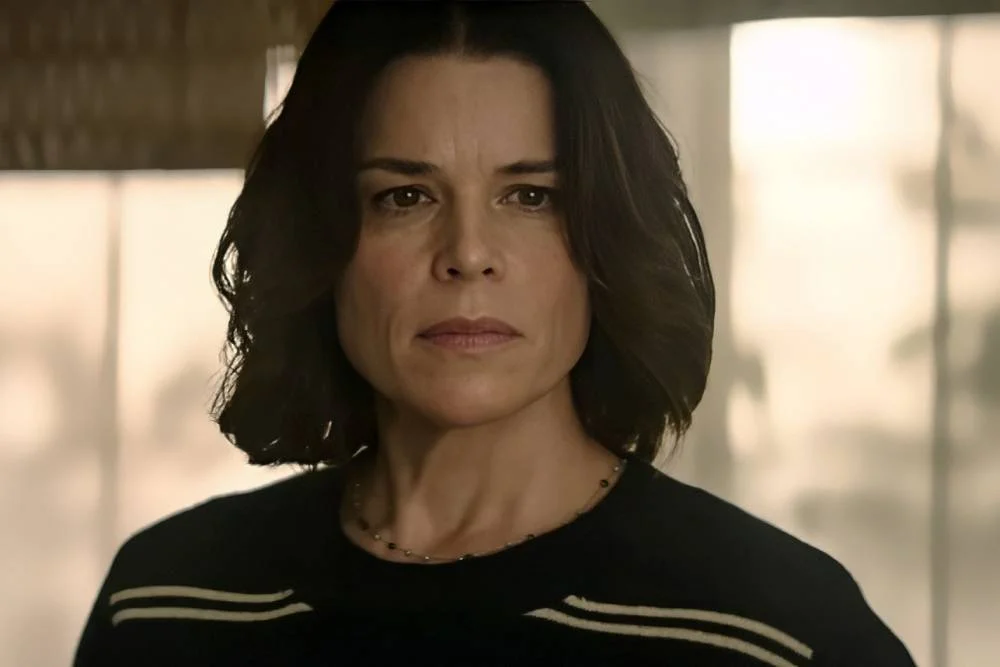
The iconic Ghostface has once again sliced its way back onto the big screen, and with its return comes the highly anticipated comeback of the franchise’s undisputed final girl, Neve Campbell’s Sidney Prescott. After a notable absence from “Scream 6,” Sidney’s presence in “Scream 7” anchors a narrative that not only delves deeper into her enduring trauma but also introduces a terrifying new dimension to the Ghostface mythology. This installment finds Sidney not just as a survivor, but as a protective mother to a teenage daughter, Tatum (Isabel May), whose own coming-of-age is violently interrupted by the masked killer. True to “Scream” form, the film delivers a visceral blend of gruesome kills, heart-stopping suspense, and a shocking unmasking that twists expectations, all while weaving in nostalgic cameos that pay homage to its storied past.

The latest rampage begins with a chilling nod to the franchise’s roots. Horror film enthusiasts Scott (Jimmy Tatro) and Madison (Michelle Randolph) meet a brutal end after renting what appears to be a picturesque, yet ominously familiar, house. Fans will immediately recognize it as the former residence of the original “Scream” killer, Stu Macher (Matthew Lillard), a location steeped in cinematic dread. This opening sequence skillfully sets a tone of both reverence for the past and a clear signal that no one is truly safe. Shortly thereafter, Sidney, now residing in the seemingly tranquil Pine Grove, receives a disturbing, anachronistic message. It’s from Stu himself, claiming to have miraculously survived his apparent demise in the original film and vowing revenge against Sidney and her family. This audacious claim immediately reignites one of the franchise’s most persistent fan theories, sending shivers down the spine of both characters and audience alike. The first wave of terror then escalates, with one of the Ghostfaces targeting Tatum’s classmate, Hannah (Mckenna Grace), at her high school play rehearsal, before making a direct, terrifying approach toward Sidney’s sanctuary.
The sanctity of Sidney’s home is shattered as Ghostface launches a direct assault. What follows is a desperate struggle involving Sidney, her steadfast husband Mark (Joel McHale), and her daughter Tatum. The domestic battlefield transforms into a scene of pure terror, culminating in a dramatic moment where the tables are momentarily turned. In a thrilling intervention, veteran reporter Gale Weathers (Courteney Cox) crashes onto the scene, literally, running over the assailant with her vehicle. Gale, ever the tenacious journalist, is accompanied by her new camera crew, comprised of the resilient siblings Mindy (Jasmin Savoy Brown) and Chad Meeks-Martin (Mason Gooding), familiar faces from the preceding two “Scream” installments. Their arrival not only provides crucial assistance but also bridges the generations of survivors. The unmasked Ghostface is revealed not as Stu, but as an unknown murderer who had recently escaped from a local insane asylum and developed a dangerous obsession with Sidney. This twist initially grounds the horror in a more conventional, psychological threat, suggesting a stalker narrative. Seeking answers and grappling with the chilling possibility of Stu’s survival, Sidney visits the mental institution. There, a conversation with a supervisor deepens the mystery, as the supervisor confirms, with an unnerving lack of detail, that Stu Macher had indeed “apparently survived” his original death.

With the initial Ghostface apprehended, the true architect of the terror begins to reveal their hand, escalating the body count and deepening the psychological torment. Tatum’s inner circle becomes the next target, as her friend (Celeste O’Connor), Sidney’s neighbor’s son Lucas (Asa Germann), and Tatum’s boyfriend Ben (Sam Rechner) are all brutally murdered. Mark, Sidney’s husband, is gravely wounded but ultimately survives, adding to the mounting personal stakes for the Prescott-Kincaid family. As the investigation progresses, the seemingly impossible return of Stu Macher is unveiled as a horrifying technological deception. The “Stu” delivering the eerie messages and orchestrating the early psychological warfare is revealed to be an AI deepfake, a sophisticated digital fabrication. This chilling revelation not only grounds the film in contemporary fears surrounding artificial intelligence and misinformation but also adds a meta-commentary on the enduring power of legacy characters in a digital age. The mastermind behind this terrifying technological manipulation is Marco (Ethan Embry), the very supervisor from the mental institute Sidney had visited. Marco leverages this sinister AI, not just to impersonate Stu, but to conjure other spectral figures from Sidney’s traumatic past, including the late Sheriff Dewey Riley (David Arquette), the chilling Ghostface from “Scream 2,” Nancy Loomis (Laurie Metcalf), and the manipulative killer from “Scream 3,” Roman Bridger (Scott Foley). These digital specters serve to psychologically torture Sidney, forcing her to confront her deepest fears and the ghosts of her past in a terrifying new format, blurring the lines between memory, reality, and digital illusion.
As the digital layers of deception are peeled back, the true, human face of evil is finally unmasked, revealing a twist that hits chillingly close to home for Sidney. The real brains behind the entire Ghostface killing spree is none other than Sidney’s seemingly innocuous neighbor, Jessica (Anna Camp). Her motivation is a disturbing reflection of modern celebrity obsession and a grotesque perversion of Sidney’s own journey. Jessica confesses that she was profoundly “inspired” by Sidney’s widely acclaimed autobiography, misinterpreting Sidney’s survival and resilience as a template for achieving her own twisted version of success. Believing that she needed to commit a horrific act, specifically murdering her own husband, to reach the same level of notoriety and public fascination as Sidney, Jessica’s plan faltered. When this initial scheme failed to garner the desired outcome, her obsession intensified, leading her to discover Sidney’s new residence. This proximity allowed her to insinuate herself into Sidney’s life, and crucially, to connect with Marco, the disillusioned mental institution supervisor with access to cutting-edge, illicit deepfake technology. Together, they orchestrated the elaborate plot, with Jessica’s ultimate goal being to kidnap Tatum and force her through the very same harrowing Ghostface ordeal that Sidney had miraculously survived. Jessica’s warped desire for a shared, traumatic legacy underscores a dark commentary on the commodification of trauma and the insidious nature of fandom gone awry. Her actions are a horrifying testament to how one person’s triumph can be twisted into another’s destructive ambition.

The climax of “Scream 7” is a brutal and cathartic confrontation, where Sidney Prescott, alongside her daughter Tatum, fights for their lives and ultimately reclaims their peace. The final showdown pits them against both Marco and the deranged Jessica, bringing the complex web of digital deception and human malice to a violent head. Sidney, drawing upon decades of experience confronting pure evil, demonstrates once again why she is the ultimate survivor. Tatum, pushed to her limits, proves to be her mother’s daughter, exhibiting immense courage and resilience in the face of unimaginable terror. Together, they manage to overcome Marco, neutralizing the technological threat. The ultimate defeat of Jessica is a particularly visceral moment, as she is repeatedly shot in the head, ensuring a definitive end to her reign of terror and her twisted obsession. In a testament to the enduring strength of the Prescott-Kincaid family, Sidney, Tatum, and Mark all survive the harrowing ordeal. Their survival not only provides a sense of closure for this chapter but also reinforces the core theme of resilience that has defined Sidney’s character throughout the entire franchise. It’s a powerful affirmation of the bonds of family and the indomitable human spirit in the face of unimaginable horror.
With Sidney, Tatum, and Mark having faced down this latest iteration of Ghostface and lived to tell the tale, the natural question arises: could this family, now more bonded than ever, return for an eighth installment? The franchise has always excelled at evolving its narrative while maintaining its core appeal, and the survival of the primary trio certainly leaves the door wide open for future scares. Furthermore, the resilient Mindy and Chad Meeks-Martin also make it through the finale, their journalistic instincts seemingly piqued by the recent events. In a mid-credits scene that hints at new directions, they are seen shooting their own news broadcast about the killings. This development suggests a potential passing of the torch, perhaps positioning them to follow in Gale Weathers’ legendary reporting footsteps, offering a fresh perspective on the ongoing Ghostface saga. While “Scream” creator Kevin Williamson has openly shared his ideas for an eighth movie, nothing has been officially announced. The enduring popularity of the franchise, coupled with the critical success of “Scream 7” and the compelling new dynamics introduced, certainly makes a continuation seem plausible and eagerly anticipated by fans worldwide. The film leaves audiences pondering not just the immediate aftermath, but the broader implications of its innovative use of AI and the ever-present question of how trauma shapes legacy.

Beyond the primary cast, “Scream 7” also paid homage to its rich history through a series of impactful, albeit digitally manipulated, cameos. As revealed through Marco’s sinister use of AI deepfake technology, several beloved and feared characters from past “Scream” films made an appearance, albeit in a terrifyingly twisted form. These included the late Sheriff Dewey Riley, Nancy Loomis (Ghostface from “Scream 2”), and Roman Bridger (the killer from “Scream 3”). While not physical returns, their digital manifestations served as potent psychological weapons against Sidney, reminding both her and the audience of the deep, personal scars left by Ghostface throughout the decades. This innovative approach to cameos allowed the film to tap into the franchise’s extensive lore in a fresh, unsettling way, blurring the lines between memory, trauma, and the evolving threats of the digital age.
(Image Gallery: Visuals showcasing the digital cameos from past “Scream” characters as they appeared in “Scream 7” would be placed here.)