



Vegas on Vellum: How ‘Strip Law’ Reimagines Sin City’s Legal Circus Through Animation
Las Vegas, a city synonymous with spectacle, illusion, and a touch of the outrageous, has long been a fertile ground for television narratives, from the gritty crime scenes of “CSI” to the comedic backstage drama of “Hacks.” Yet, no live-action series has quite managed to bottle the essence of Sin City’s inherent absurdity with the same vibrant, unbridled freedom as Netflix’s animated comedy, “Strip Law.” Conceived by Cullen Crawford, an alumnus of the renowned satirical site ClickHole and a veteran writer for “The Late Show With Stephen Colbert,” this series leverages the boundless potential of its medium to construct a fictional Vegas that often outstrips the bizarre realities of its real-world counterpart. Here, the boundaries of logic and decorum are mere suggestions, allowing for a world where annual cage matches pit magicians against animals, the esteemed beret-wearing comedian George Wallace holds the mayoral office, and a law firm’s client roster includes an Austin Powers impersonator facing charges for an unfortunate incident involving an infant. It’s a testament to animation’s unique power to not just reflect reality, but to elevate it into a realm of delightful, exaggerated truth, making “Strip Law” an unparalleled exploration of Las Vegas’s singular spirit.
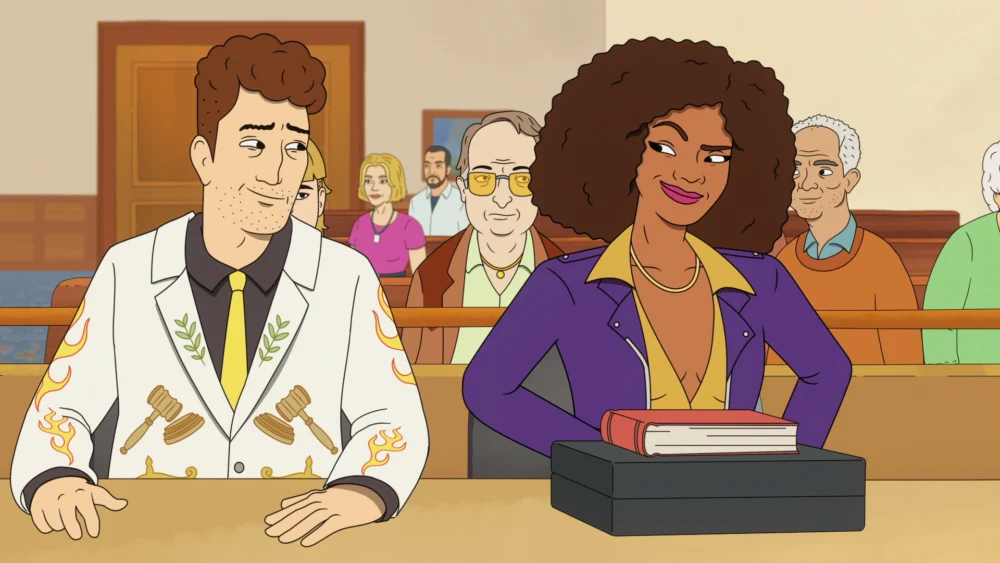
At the heart of this meticulously crafted chaos is the law firm inherited by Lincoln Gumb, voiced with a perfectly pitched blend of earnestness and exasperation by Adam Scott. Lincoln is a character caught between worlds: a genuinely capable attorney with a staunch adherence to legal principles, yet utterly lacking the theatrical flair essential to sway a Las Vegas jury, notorious for its jadedness and unpredictable whims. His predicament is encapsulated early on by a poignant observation from a local, who tells him, “You’re a Vegas lawyer, but you think you’re better than Vegas.” This encapsulates Lincoln’s core conflict: his desire to practice law with integrity clashing with the city’s demand for performance. His mother, a legendary figure in Vegas legal circles, built the firm on a foundation of both legal acumen and local understanding, a legacy Lincoln struggles to uphold and redefine.
Lincoln’s professional and personal journey takes a dramatic turn with the arrival of Sheila Flambé, an enigmatic magician voiced by the inimitable Janelle James. Sheila, a self-proclaimed “human highlight reel,” is brought into the firm not as another attorney, but as its creative director – a title as unconventional as her methods. Her role is to infuse Lincoln’s diligent, if somewhat dry, legal work with the much-needed “razzle-dazzle” required to captivate and convince the local populace. Where Lincoln might meticulously craft a legal brief, Sheila is prepared to, for example, intentionally electrocute herself in court to disprove the existence of heaven, an audacious tactic that, remarkably, “Strip Law” manages to contextualize within its own eccentric logic. Sheila’s presence is a catalyst, forcing Lincoln to confront his own reservations about showmanship and to embrace the peculiar theatricality that defines justice in this animated Sin City. Her character is a masterclass in comedic timing and embodies the wild, unpredictable energy that makes the show so compelling, echoing and even surpassing the flamboyant confidence Janelle James brought to her breakout role as Principal Ava in “Abbott Elementary.”
The eccentric ecosystem of the Gumb law firm extends beyond Lincoln and Sheila to a memorable supporting cast, each member contributing to the firm’s unique brand of legal theatrics. There’s Irene, Lincoln’s surly teenage niece, brought to life by Shannon Gisela. Irene serves as the firm’s in-house investigator, her adolescent cynicism proving surprisingly effective in navigating the peculiar underbelly of Vegas. Her youthful perspective often cuts through the adults’ pretensions, offering a grounded, albeit sarcastic, counterpoint to the firm’s more outlandish strategies. Then there’s Glem Blorchman, an aging fixer portrayed by the versatile Stephen Root, whose gruff demeanor and deep-seated knowledge of Vegas’s unspoken rules make him an invaluable, if sometimes reluctant, asset. Together, this unlikely quartet forms a dysfunctional but fiercely loyal unit, navigating the labyrinthine legal landscape of a city where the line between reality and illusion is perpetually blurred. Their individual quirks and collective chemistry are vital in grounding the show’s more fantastical elements, ensuring that even amidst the most absurd scenarios, there’s a tangible sense of a team fighting for their clients, however strange those clients may be.
Much like the enduring adage about “Sex and the City,” where New York City itself was considered the fifth main character, “Strip Law” elevates Las Vegas to the status of its undisputed star. Creators Cullen Crawford and his writing team pour an incredible amount of affection and detail into building an exaggerated, yet deeply recognizable, sense of place. This isn’t just a backdrop; it’s a living, breathing entity that shapes the narrative and the characters within it. The show’s opening credits are a masterclass in visual storytelling and comedic world-building. Boasting the tongue-in-cheek declaration that the series was “proudly made by real, non-computer human beings,” these sequences whisk viewers past a constantly rotating gallery of storefronts on the titular iconic street. Each episode unveils new, increasingly absurd businesses and landmarks that reflect the show’s particular brand of humor and its satirical take on Vegas culture. From “Circumcision by Elvis” to the “Mafia Goons Hall of Fame,” and the unapologetically named “Sexxxual Grocery Store,” these fleeting glimpses are not just sight gags; they are mini-narratives, each sign a tiny window into the boundless imagination and meticulous detail that defines the show’s universe. They serve as a constant reminder of the city’s unique blend of the sacred and the profane, the glitzy and the gritty, all filtered through a lens of animated absurdity.
The comedic brilliance of “Strip Law” stems from its remarkable joke density, a quality that feels refreshingly rare in contemporary television. The show’s writers pack each episode with a barrage of gags, witty dialogue, and unexpected visual humor, ensuring that viewers are constantly engaged and entertained. This rapid-fire comedic style, coupled with the impeccable vocal performances, makes the series enormously likable. Adam Scott, as previously noted, is perfectly cast as the beleaguered straight man, whose tightly wound composure is a perfect foil for the chaotic energy around him. His character’s “terminal case of Pete Buttigieg energy,” as diagnosed by Sheila, is a wonderfully specific and hilarious descriptor that immediately encapsulates his earnest, slightly buttoned-up persona. Janelle James, on the other hand, delivers a performance that is nothing short of a comedic tour de force. Sheila Flambé is an even more flamboyant and unpredictable wild card than her breakout character Principal Ava, pushing the boundaries of what a legal “creative director” can be with an infectious confidence and a penchant for the dramatic. The interplay between Scott’s restrained earnestness and James’s uninhibited theatricality forms the comedic backbone of the series, creating a dynamic that is both hilarious and surprisingly heartfelt.
Beyond its immediate comedic appeal, “Strip Law” also engages in a clever meta-commentary, gently poking fun at the very legal procedural genre it inhabits. The show openly acknowledges and subverts the conventions of weekly case dramas, with characters often breaking the fourth wall or making self-aware observations about the narrative structure. A particularly memorable line, “We just have to cut to the last part of these weekly cases where we do something inventive but kind of stupid and then win!”, perfectly encapsulates this playful deconstruction. This meta streak adds another layer of intelligence to the humor, inviting viewers to appreciate the show’s ingenuity not just in telling a story, but in commenting on the storytelling process itself. Furthermore, “Strip Law” boldly experiments with its visual style, transcending traditional animation boundaries. Sequences can suddenly shift into the aesthetic of anime, or even transition into live-action segments, often featuring cameos from recognizable comedians. This visual versatility not only keeps the viewer engaged but also underscores the show’s commitment to pushing creative boundaries, using the animated medium as a springboard for endless imaginative possibilities rather than a restrictive format. It’s a bold artistic choice that ensures the show never settles into a predictable rhythm, always offering fresh surprises.
What elevates “Strip Law” beyond mere comedic brilliance is its deftly cultivated backstory, which imbues Lincoln’s arc with significant emotional stakes. Far from being just a vehicle for jokes, the series explores themes of legacy, identity, and the complicated relationship one can have with their hometown. Lincoln’s late mother, a formidable Vegas lawyer in her own right, partnered with Steve Nichols (voiced by Keith David), establishing the firm’s storied reputation. The firm’s jingle – “Nichols and Gumb, they’re two things in your pocket…” – is a testament to their local fame, an earworm that gets stuck in the viewer’s head, much like it lingers in Lincoln’s consciousness. Yet, as the narrative unfolds, we learn that despite her professional prowess, Lincoln’s mother was a subpar parent. This revelation adds a profound layer of complexity to Lincoln’s character, as he grapples not only with the professional shadow of a legal legend but also with the personal void left by an emotionally distant mother. His attempts to both live up to her formidable legacy and, perhaps more importantly, to overcome her personal shortcomings, reflect his own evolving and often complicated relationship with Las Vegas itself. The city, known for its ability to both make and break individuals, has certainly done a number on its visitors, but it holds a uniquely challenging sway over its natives, particularly those tied to its peculiar history. Lincoln’s journey is thus a universal tale of finding one’s own path amidst the expectations of family and place.
Ultimately, “Strip Law” proves to be an infectious watch, captivating audiences with its unique blend of wit, visual innovation, and genuine heart. The show’s palpable fondness for vintage flair and classic showmanship is evident in every frame, creating an aesthetic that feels both nostalgic and refreshingly contemporary. It celebrates the inherent theatricality of Las Vegas, transforming it into a vibrant, living character that influences every aspect of the narrative. This is a series that understands the delicate balance between the dazzling illusion and the gritty reality of Sin City, and it revels in exploring the bizarre intersections where they meet. Where else could a virtual reality HR training avatar be a composite of every member of the Rat Pack, perfectly embodying the city’s enduring fascination with its iconic past while embracing its technologically advanced present? “Strip Law” is more than just an animated comedy; it’s a love letter to the quirks, eccentricities, and undeniable allure of Las Vegas, inviting viewers to embrace the outlandish and find the extraordinary in the everyday legal battles of this most extraordinary city.