



From the brilliant mind that gifted the world the riotous charm of “Derry Girls” comes a new, more ambitious chapter in Northern Irish storytelling. Lisa McGee, a celebrated architect of authentic and uproarious narratives, invites audiences into a world that, at first glance, feels comfortably familiar yet quickly unravels into a tapestry of dark secrets and unresolved trauma. Her latest creation, “How to Get to Heaven from Belfast”—or simply “Belfast,” as many will affectionately abbreviate it to avoid carpal tunnel from its rather lengthy title—marks a significant evolution in her craft. It’s a show steeped in the same irreverent humor, the same deeply rooted sense of place, and the same chaotic energy of tightly-knit Northern Irish women prone to nervous chatter and impulsive decisions that made “Derry Girls” a global phenomenon. However, “Belfast” is a departure into murkier, more complex waters, embracing dual timelines, deadly intrigue, and a significantly expanded narrative scope that truly showcases McGee’s growth as a storyteller. Initially conceived for Channel 4, the series found its home on Netflix, a move indicative of both its rising production demands and the platform’s desire to capitalize on the fervent international following McGee cultivated. The presence of Saoirse-Monica Jackson, beloved as the perpetually anxious Erin Quinn in “Derry Girls,” further solidifies the connection, serving as a delightful, if slightly meta, nod to McGee’s loyal fanbase. While “Belfast” occasionally strains under the weight of its increased ambition, it never loses sight of the infectious, authentic platonic chemistry that forms its vibrant, beating heart.
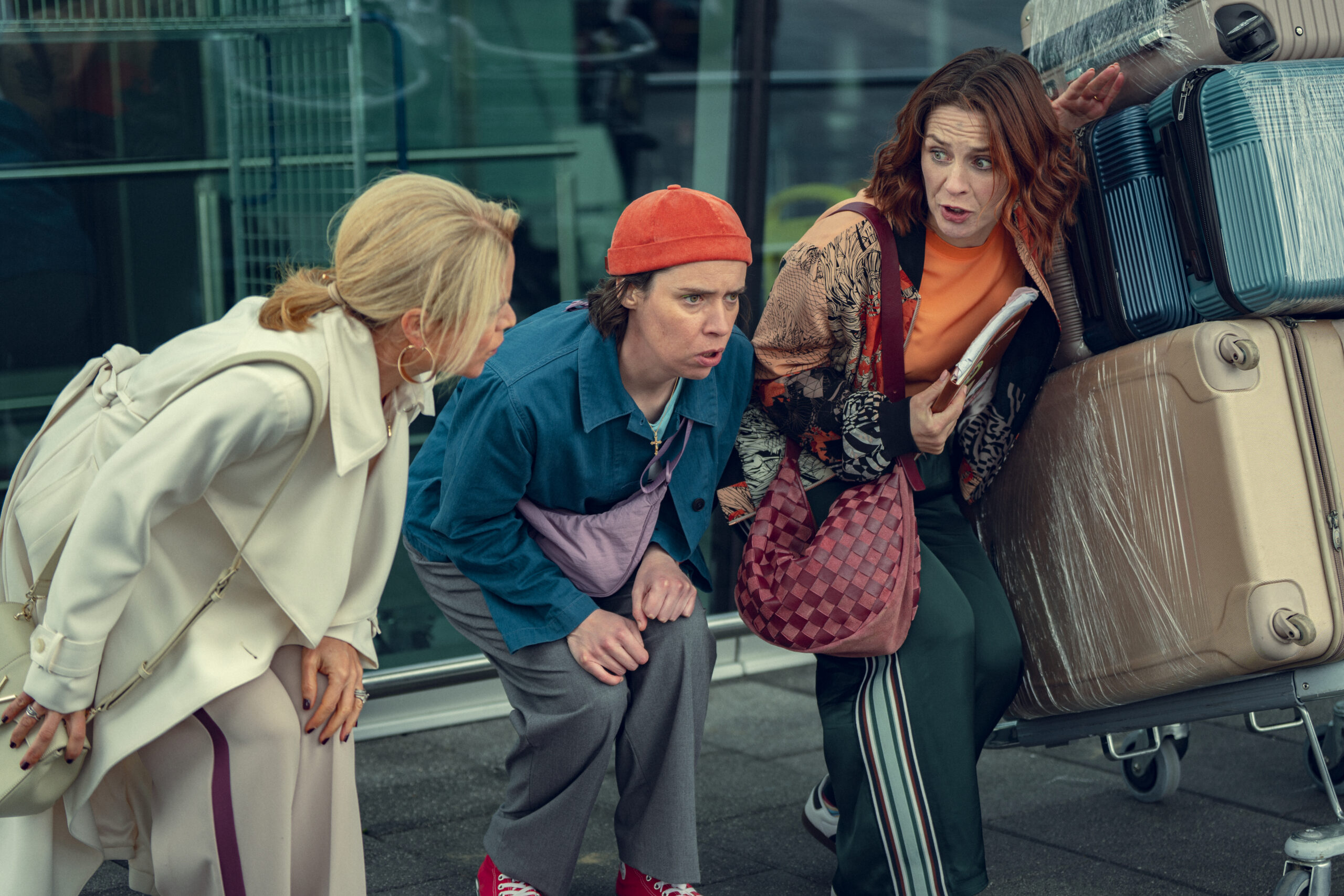
At the core of this compelling new series are three women, Saoirse (Roisin Gallagher), Robyn (Sinéad Keenan), and Dara (Caoilfhionn Dunne), whose bond was forged in the hallowed, often hilarious, halls of an all-girls Catholic secondary school. Much like McGee herself, and the fictional “Derry Girls” inspired by her own upbringing, this trio shares a history rooted in the unique educational and social landscape of Northern Ireland. However, unlike Erin and her friends, Saoirse, Robyn, and Dara navigated their formative years in the early 2000s, a crucial period post-Good Friday Agreement. This timing positions “The Troubles” not as an active, omnipresent threat, but as a fresh, raw memory—a recent past that subtly, yet profoundly, shapes their present-day perspectives and anxieties. Two decades have passed since their graduation, and the women now find themselves in their late thirties, each grappling with a distinct flavor of dissatisfaction. Saoirse, seemingly a surrogate for McGee herself, is a successful London-based creator of a hit TV show. Yet, beneath the veneer of achievement, she harbors a deep-seated disdain for her schlocky crime drama, “Murder Code,” and its egocentric leading actress, revealing the often-unseen struggles of creative compromise and unfulfilled passion. Dara, on the other hand, lives a life marked by quiet resignation, her closeted lesbian identity and the responsibility of caring for her elderly mother serving as a convenient, albeit heartbreaking, excuse to avoid building a life of her own. Robyn embodies a different kind of entrapment; a wealthy housewife, she finds herself utterly exhausted by the relentless demands of her three rambunctious children, her privileged existence a gilded cage of domesticity. Each character offers a nuanced exploration of the compromises, regrets, and unspoken desires that define womanhood in contemporary society.
The fragile equilibrium of their lives is shattered by the sudden, suspicious death of the quartet’s missing fourth member, Greta (Natasha O’Keeffe). Greta, with whom the others lost touch after a fateful night two decades prior, becomes the enigmatic catalyst for the narrative’s unfolding mystery. Her family’s claim of a freak fall down the stairs rings hollow, immediately threatening to unearth a trove of long-suppressed secrets the group has desperately tried to bury. The journey to rural County Donegal for Greta’s wake, crossing the invisible yet potent border that divides Ireland, instantly puts the women on edge. This sense of unease escalates dramatically as events unfold. The invitation, supposedly from Greta’s sister-in-law, is quickly exposed as a fabrication when her widower, Owen (Emmett J. Scanlan), reveals he has no sister. Further compounding the mystery, a friendly Englishman at the local pub bears an unsettling resemblance to Greta’s ex-boyfriend, Jason (Josh Finan), whose unexplained disappearance twenty years ago lies at the very heart of the group’s guarded silence. The tension culminates when Saoirse, with her writer’s keen eye for detail, sneaks a peek inside the casket, emerging convinced that the body within is not Greta’s. The premiere’s chilling final reveal confirms her darkest suspicions, assuring viewers that the lines between fiction and reality within the narrative are indeed blurred, and the writer protagonist isn’t just weaving another fictional tale.
The premise of a group of Irish women bound by a high-stakes code of silence inevitably draws comparisons to Sharon Horgan’s critically acclaimed “Bad Sisters,” particularly its masterful first season. There are even specific plot beats that echo Horgan’s work, such as an ill-advised flirtation between the engaged Saoirse and Liam (Darragh Hand), a local police officer. Indeed, the protagonists of “Belfast” are so intimately intertwined, so quick to quarrel and forgive, that they could easily pass for siblings, much like the Garvey sisters in “Bad Sisters.” Yet, despite these structural and thematic similarities, Lisa McGee’s distinctive voice shines through, ensuring “Belfast” carves out its own unique identity. While “Derry Girls” was largely a singular vision, “Belfast” benefits from a writers’ room, a shift that allows for a broader range of perspectives while still retaining McGee’s signature blend of sharp wit and heartfelt emotion. The complexities of the relationships among Robyn, Dara, and Saoirse are particularly well-drawn. Their interactions are imbued with the brutal honesty only old friends can wield, as they unhesitatingly call each other out for Robyn’s self-absorption, Dara’s pervasive cowardice, and Saoirse’s often-unseemly appetite for excitement. These moments of candid confrontation are both comedic and poignant, revealing the enduring power and occasional strain of their decades-long bond. The performances of the lead actresses are nothing short of revelatory. Roisin Gallagher brings a flustered charm to Saoirse, perfectly balancing her intelligence with her anxieties. Sinéad Keenan’s portrayal of Robyn captures a shameless hauteur mixed with genuine vulnerability. Caoilfhionn Dunne’s elastic face and nuanced expressions ensure Dara’s internal struggles are palpable, delivering laughs even as her character navigates profound personal dilemmas. These actresses masterfully convey the jadedness and weariness of women approaching forty, yet never lose the spark of the spirited teens they once were.
Greta, the missing link in this tangled web, remains by design a more obscure figure. Her backstory is deliberately fuzzy, emphasizing her role as an outsider. In Ireland, the concept of being forever known as “the transfer student” years after arriving at a new school highlights how community memory can brand individuals, marking Greta (portrayed in flashbacks by the ethereal Emma Canning) as an enigma even before her fateful troubles began. This intentional fuzziness, however, comes at a cost. Because “Belfast” spends significantly less time developing Greta’s character in the present day, the late-breaking revelations about her past and its far-reaching consequences don’t always land with the same emotional resonance as the more steadily constructed portraits of her peers. She risks becoming more of a plot device than a fully realized individual, serving primarily as a canvas onto which the “actual” main characters project their fears, guilt, and unresolved issues. A brief, almost throwaway clip in the finale reveals Greta as a photographer, developing photos in a darkroom. This neat detail, unfortunately, arrives too late in the narrative to be explored for its potential insights into her adult life, her artistic eye, or how it might have connected to the broader mystery. It’s a poignant missed opportunity to deepen a character who is pivotal to the entire story, yet remains frustratingly out of focus.
As the narrative progresses, Saoirse and her friends quickly cross paths with Booker (Bronagh Gallagher), a menacing fixer whose suspicious demeanor is only confirmed when Greta is seen tied up in her trunk. This encounter serves as the first thread in an intricate “nesting doll of intrigue” that slowly unfurls. By season’s end, viewers are bombarded with a cascade of interconnected mysteries: the identity of Booker’s employer, the true occupant of the casket if not Greta, the events that transpired with Greta in the 2020s, the unresolved disappearance of Jason from the 2000s, the childhood trauma that led Greta to Our Lady of the Sorrows Cottage in the 1990s, and the cryptic significance of a creepy symbol tattooed on all four women at Greta’s insistence. It’s a dizzying array of interconnected timelines and revelations, demanding significant mental gymnastics from the audience. To be candid, the sheer volume of plot points, while intriguing on paper, sometimes overshadows the very element that makes “Belfast” truly shine: the dynamic, authentic interactions between the lead actresses. The complex web of conspiracies, while necessary for the thriller aspect, often feels less compelling than simply watching Saoirse, Robyn, and Dara bounce off one another, their long-standing friendship and raw emotional exchanges providing the series’ most captivating moments. The final shot, a clear telegraphing of hopes for a second season, underscores this point; it’s the prospect of spending more time with these flawed, hilarious, and deeply human characters that resonates most strongly, rather than merely a desire for a resolution to the cliffhanger. The resounding takeaway is an enthusiastic anticipation for more.
“Belfast” culminates in a resolution that, despite its earlier narrative complexities, leans somewhat heavily on the now well-worn conventions of the “trauma plot.” This popular storytelling device, which often links current events to past psychological wounds, can feel trope-laden if not handled with exceptional care. However, any potential predictability in its payoff is powerfully countered by the extraordinary specificity and profound sense of place that Lisa McGee masterfully builds on both sides of the Irish border. Critical scenes often hinge on the nuanced use and meaning of the Irish language, a subtle yet powerful affirmation of cultural identity and heritage that adds layers of authenticity for a women-focused audience interested in global storytelling. Catholicism, a pervasive force in Irish society, suffuses every aspect of the characters’ lives, from their schooling to their moral dilemmas, shaping their worldview and internal conflicts. Moreover, the long, lingering hangovers of “The Troubles” and the historical impact of abortion bans are palpable, even if the original causes are no longer actively defining the present. While “Derry Girls” ingeniously mined comic gold from the ordinary lives led amidst geopolitical turmoil, “Belfast” courageously carries that rich tradition forward into the aftermath of conflict. It explores how the collective and personal scars of history manifest in adulthood, tinged with the hindsight, regrets, and hard-won wisdom that only time can bring. The series offers a compelling and often darkly humorous reflection on how the past continues to shape the present, particularly for women grappling with inherited histories and personal burdens.
All eight episodes of “How to Get to Heaven from Belfast” are now streaming on Netflix, offering a powerful, poignant, and often hilarious journey into the heart of Northern Irish womanhood.