

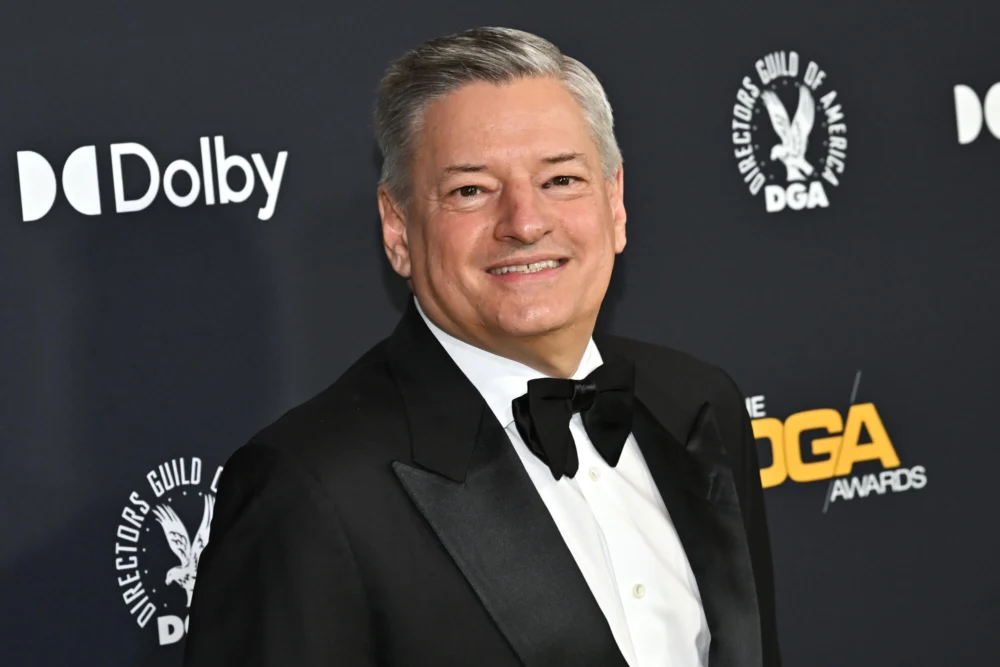
In a candid and wide-ranging interview, Netflix co-CEO and chief content officer Ted Sarandos has publicly addressed the intense scrutiny surrounding the company’s ambitious bid for Warner Bros. Discovery’s streaming assets, deftly batting away political interference from former President Donald Trump and outlining a vision for growth that contrasts sharply with rival proposals. Speaking from London, Sarandos positioned Netflix’s pursuit of a landmark deal as a purely business-driven endeavor, emphasizing its potential to expand the entertainment landscape rather than consolidate it.
The high-stakes corporate maneuvering has recently been complicated by an unexpected political intervention from Donald Trump, who took to social media to demand Netflix fire board member Susan Rice and halt its acquisition efforts. “He likes to do a lot of things on social media,” Sarandos remarked with a measured tone on BBC Radio 4’s “Today” program, responding to host Amol Rajan’s query about the former president’s online directive. Sarandos firmly reiterated Netflix’s stance: “This is a business deal. It’s not a political deal. This deal is run by the Department of Justice in the U.S. and regulators throughout Europe and around the world.” His comments underscored the company’s commitment to navigating the complex regulatory landscape based on economic principles, not political whims.
Trump’s social media broadside, issued on Sunday, saw him amplify a post from conservative influencer Laura Loomer, which urged him to “kill the Netflix-Warner deal.” Trump’s added commentary was pointed, demanding that “Netflix should fire racist Trump deranged Susan Rice immediately, or pay the consequences.” Susan Rice, a distinguished figure with a long career in public service, notably serving as National Security Advisor and U.S. Ambassador to the United Nations under President Barack Obama, has been a member of Netflix’s board of directors since 2018. Her appointment was hailed at the time for bringing valuable geopolitical expertise to the global streaming giant. Trump’s targeting of Rice, a prominent Democratic voice and a former high-ranking diplomat, appears to be a politically motivated attempt to leverage corporate decisions for ideological ends, a tactic he has frequently employed. Sarandos’s swift dismissal of these demands highlights the delicate balance major corporations must strike when their strategic business moves intersect with contentious political narratives.
The BBC interview provided a crucial platform for Sarandos to articulate Netflix’s strategy amidst a pivotal moment for the company and the broader entertainment industry. His appearance in London followed the BAFTA Film Awards, which he attended, and preceded a significant announcement regarding a fresh donation to the National Film and Television School – a testament to Netflix’s ongoing investment in talent development and production infrastructure globally. With a formidable subscriber base of approximately 320 million worldwide, including nearly 20 million in the U.K. alone, Netflix wields considerable influence and its every strategic move sends ripples across the media landscape.
The immediate backdrop to Sarandos’s remarks was the escalating contest for Warner Bros. Discovery, a sprawling media conglomerate with highly coveted assets ranging from the iconic Warner Bros. studio and its vast film and television library to premium cable networks like HBO and news powerhouse CNN, alongside the Max streaming service. Netflix had initiated the current bidding war on December 5, tabling an $83 billion offer specifically for Warner Bros. Discovery’s streaming and content production assets. Just three days later, on December 8, a formidable rival emerged: Paramount, led by David Ellison, the son of Oracle founder Larry Ellison, launched a hostile counter-bid for the entire Warner Bros. Discovery company, valuing it at a significantly higher $108 billion. Despite Paramount’s more encompassing offer, the Warner Bros. Discovery board has consistently expressed a preference for the Netflix proposal, signaling a strategic alignment. However, they granted Paramount a firm deadline until later that Monday to submit its “best and final bid,” intensifying the tension and leaving the industry on tenterhooks.
Sarandos made an unequivocal case for the Netflix deal, framing it as a catalyst for expansion and job creation. “Our deal is growth,” he declared, emphasizing Netflix’s substantial commitment to creative industries worldwide. He cited the company’s investment of $6 billion in original programming in the U.K. since 2020, a commitment that has directly led to the creation of an estimated 50,000 jobs within the British creative sector. This investment underscores Netflix’s strategy of fostering local production hubs, benefiting regional economies and diverse talent pools.
In stark contrast, Sarandos characterized the Paramount approach as a relic of an outdated industry model. He labeled it “the classic horizontal media mergers that are always bad for consumers, always bad for creators.” Horizontal mergers, where direct competitors combine, often raise antitrust concerns by reducing competition and potentially leading to higher prices or fewer choices for consumers. Sarandos warned of dire consequences should Paramount’s bid succeed, specifically that Hollywood’s traditional “Big Five” major studios would be further reduced to just four, indicating a dangerous trend towards market concentration. He further highlighted Paramount’s stated intention to implement $6 billion in immediate business cuts upon a deal’s closure, with an additional $16 billion in cuts deemed necessary to deleverage the combined entity’s debt. “You look at that and think, ‘Wow, this industry will be much smaller under that ownership than it would be under Netflix ownership,'” Sarandos observed, painting a picture of austerity and contraction versus Netflix’s promise of expansion.
When pressed by Rajan to articulate the argument he might present to Donald Trump regarding the Netflix deal, Sarandos circled back to its core growth credentials. He explained that Netflix’s proposal represents a “vertical merger,” a strategic acquisition where a company expands into different stages of the same supply chain. “We’re buying assets that we don’t currently have — a movie studio and a distribution entity,” he clarified. This distinction is crucial; unlike horizontal mergers that reduce competition, vertical mergers like Netflix’s acquisition of a studio are often seen as adding new capabilities and efficiencies, thereby contributing to the market rather than shrinking it. This narrative positions Netflix as an innovator looking to integrate and enhance its content ecosystem, rather than simply absorbing a competitor.
The conversation also delved into the controversial role of sovereign wealth funds in the Paramount consortium, which at one point reportedly included Jared Kushner. Sarandos expressed strong reservations about foreign governments holding significant financial stakes in news networks, particularly given the implications for editorial independence. “I think it’s a bad idea, typically,” he stated unequivocally. He specifically noted that some of the Gulf states involved “are not very big on the First Amendment,” referring to the principle of free speech and press freedom enshrined in the U.S. Constitution. The suggestion that these entities would exercise no editorial influence over major news outlets like CNN and CBS, Sarandos added, “seems very odd to me, with the level of investment that we’re talking about.” His comments tap into broader anxieties about foreign influence in media ownership and the potential erosion of journalistic integrity.
Sarandos also addressed criticism from acclaimed filmmaker James Cameron, who had penned a letter to the chair of the Senate antitrust subcommittee, warning that a Netflix acquisition would be “disastrous for the theatrical motion picture business.” Sarandos found Cameron’s intervention “disingenuous,” revealing that he had personally met with the director on December 20. During their conversation, Sarandos said he discussed Netflix’s commitment to maintaining a 45-day theatrical exclusivity window for Warner Bros. films, a point of contention for many in the cinema industry. He recounted that this crucial topic occupied only “five minutes of our conversation,” with the bulk of their discussion centered on “these glasses that he’s developing for Meta to watch movies at home.” The anecdote subtly highlighted a perceived hypocrisy, given Cameron’s own exploration of home viewing technologies while publicly advocating for traditional cinema. Sarandos countered Cameron’s broader point by emphasizing the sheer volume of film consumption on Netflix: “The average Netflix member watches seven movies a month,” he stated, contrasting this with the average American’s approximately two cinema visits per year. “If more people see movies, the better, deeper, richer relationship they have with movies,” he argued, concluding, “I don’t lose any business to the movie theaters.” For Netflix, expanding access to films ultimately benefits the art form, regardless of the viewing platform.
The interview also touched upon Netflix’s impact on local content markets, particularly in the U.K., where concerns have been raised about global streamers potentially crowding out homegrown British television. Sarandos robustly pushed back against these claims, citing Netflix’s significant local investment. He revealed that the streamer currently has 59 productions underway in the U.K., with only around 17 of these being non-British projects. This statistic underscores Netflix’s strategy of commissioning and producing a substantial amount of content locally, contributing to the British creative economy. When asked pointedly whether Netflix would ever have produced ITV’s critically acclaimed “Mr. Bates vs the Post Office,” a powerful and hugely popular British drama based on a real-life scandal, Sarandos responded without hesitation: “I would have made it in a heartbeat. I’m shocked that people use that example.” His comment affirmed Netflix’s interest in impactful, culturally relevant storytelling, regardless of origin, and suggested the company’s content strategy is more aligned with diverse narratives than critics might assume.
On the parliamentary committee proposal suggesting major streamers contribute 5% of their U.K. subscriber revenue to a cultural fund specifically for British-focused drama, Sarandos expressed skepticism. He articulated a preference for market-driven approaches over mandatory levies. “Incentive works much better than obligation,” he contended, arguing that the U.K. had already reaped considerable benefits from its production incentives, which attract international projects and investment. Imposing new financial obligations, he suggested, could inadvertently undermine these established economic gains and potentially deter future investment. This perspective aligns with many global streamers who advocate for policies that encourage growth and production through tax breaks and other incentives, rather than through direct financial contributions.
Sarandos also identified YouTube as a formidable and often underestimated competitive force in the evolving media landscape. He highlighted the platform’s significant footprint, noting that it now accounts for close to 9% of all television viewing time in the U.K. What’s more, a substantial 55% of YouTube watching is now taking place on TV sets, signaling its transition from a mobile-first, user-generated content platform to a mainstream entertainment destination. Sarandos characterized screen time as a “zero-sum game” – a direct competition for viewers’ attention. “The time that you spend on a connected TV, if you’re watching one app, you’re not watching broadcast, you’re not watching BBC, you’re not watching ITV and you’re not watching any other streaming service, including Netflix,” he explained. He then questioned the strategic wisdom of studios and broadcasters continuing to supply YouTube with free programming while the platform grows at their expense, deeming it “counterproductive” in the battle for audience engagement.
Finally, Sarandos weighed in on the burgeoning world of podcasts, describing their rise as a “natural evolution of the late-night chat show.” He sees them as “the new generation of chat shows, where you don’t have to make one show that appeals to everybody.” This observation speaks to the power of niche content in the digital age. Podcasts, with their lower production costs and ability to cater to highly specialized audiences, represent a broader diversification of the entertainment landscape, allowing for a vast array of voices and topics to find an audience, further fragmenting and enriching the media ecosystem.
Sarandos’s extensive interview offered a rare glimpse into the strategic thinking at the helm of one of the world’s most influential entertainment companies. From fending off political demands to championing a vision of industry growth and navigating complex regulatory and competitive challenges, Netflix’s co-CEO painted a picture of a company relentlessly focused on shaping the future of global entertainment.