


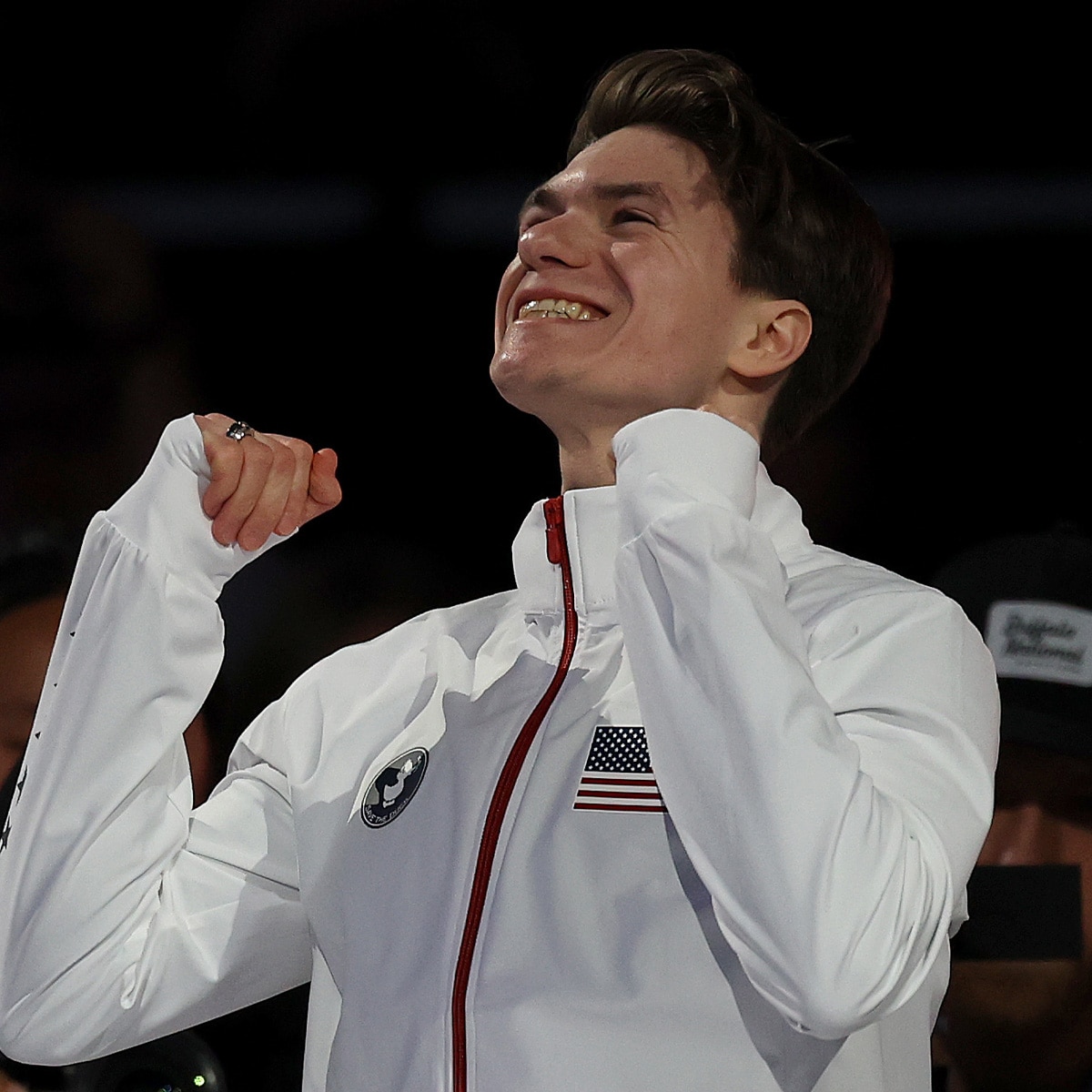
When the men’s figure skating competition begins on February 10 at the 2026 Winter Olympics in Milan, the atmosphere inside the arena will be electric, filled with the roar of a global audience and the sharp scent of freshly resurfaced ice. For 24-year-old Maxim Naumov, however, the moment will be defined by a profound, echoing silence in the stands. His parents, the people who first laced his skates and dreamed of this moment before he could even walk, will not be there to see him take the ice. They won’t be there to analyze his footwork or offer the quiet, steadying nods of approval that guided his career for nearly two decades. Yet, as Maxim prepares to represent the United States on the world’s biggest sporting stage, he carries the weight of their legacy and the warmth of their memory in every stride.
The journey to Milan has been paved with a level of grief that few could imagine, let alone navigate while under the intense pressure of elite athletics. On January 29, 2025, a tragedy struck that fundamentally altered the landscape of American figure skating. American Airlines Flight 5342, en route to Ronald Reagan National Airport, collided with a U.S. Army helicopter over the Potomac River. The catastrophic accident claimed the lives of 67 people. Among the casualties were 28 individuals deeply embedded in the U.S. Figure Skating community—athletes, coaches, and dedicated family members. Most devastatingly for Maxim, the manifest included his parents, Evgenia Shishkova and Vadim Naumov.
Evgenia and Vadim were more than just supportive parents; they were icons of the sport. As the 1994 pairs skating world champions and two-time Olympians for Russia, they possessed a technical mastery and artistic elegance that they eventually brought to the United States to share with the next generation. For Maxim, they were his North Star. Their sudden absence left a void that threatened to swallow his career and his sense of self. In the wake of the crash, the young skater found himself grappling with the existential "why" that haunts those left behind by sudden tragedy. He questioned the timing, the reason, and the sheer cruelty of losing his mentors and protectors just as he was nearing the pinnacle of his own career.
The months following the accident were a blur of mourning. Maxim has been candid about the darkness of that period, admitting that there were days when the simple act of getting out of bed felt like an insurmountable challenge. The ice, which had always been his sanctuary, suddenly felt cold and foreign. He described a desire to simply "rot" on his couch, paralyzed by the weight of his loss. But in the depths of that despair, a realization began to take hold. He understood that while grief was a destination he could choose to stay in, it was not the path his parents had built for him.
To find his way back, Maxim returned to the place where he felt closest to them: the rink. He stepped up to take over the development program his parents had founded at the Skating Club of Boston, a specialized school for children aged 4 to 7. Working with these young skaters—seeing their wobbles, their falls, and their pure, unadulterated joy—provided a bridge back to his own childhood. It reminded him of the goal he and his parents had set together when he was only five years old. It wasn’t just his dream anymore; it was a family mission.
The transition back to competitive skating required more than just emotional fortitude; it required a new technical foundation. Maxim turned to Vladimir Petrenko, a longtime family friend and a man who understood the gravity of the situation. Taking on the role of Maxim’s coach was not a decision Petrenko took lightly. He felt an enormous sense of responsibility, not just to the athlete, but to the memory of Evgenia and Vadim. He wasn’t just teaching a skater; he was honoring the values and the love that his friends had poured into their only son. Alongside Vladimir’s wife, Elena Petrenko, Maxim began the grueling process of rebuilding his programs and refining his jumps.
As he worked toward the 2026 Olympics, Maxim’s support system expanded to include a tight-knit circle of allies. His roommate and fellow Olympian Spencer Howe, choreographer Benoît Richard, and his godparents, Tony and Gretta Bogdan, became his emotional anchors. The Bogdans, in particular, stepped in to help manage the complex and painful affairs left behind after his parents’ passing, allowing Maxim to focus on the Herculean task of training.
Despite the heavy emotional toll, Maxim worked to maintain a sense of balance. In a world of quadruple jumps and high-stakes judging, he found solace in the mundane. To the public, he is an elite athlete, but his social media reveals a young man who finds joy in simple pleasures. He practices "contrast therapy"—alternating between the searing heat of a sauna and the bone-chilling cold of a plunge pool. He unwinds by playing video games with friends, binge-watching series like the gritty antihero drama The Boys, and listening to a playlist dominated by Eminem and Westside Gunn. He even picked up table tennis after being inspired by the film Marty Supreme. When asked about his culinary skills during a Team USA interview, he offered a deadpan response that resonated with fans for its relatability: his "best" dish is a bowl of cereal.
This humanity is what makes his performance on the ice so compelling. At the U.S. Figure Skating Championships in St. Louis, the pressure reached a fever pitch. Sitting in fourth place after a short program set to Frédéric Chopin’s "Nocturne No. 20," Maxim knew he was on the bubble for the Olympic team. In the "kiss and cry" area, while awaiting his scores, he held a tattered photograph—a snapshot of him at age two, standing on the ice for the first time, flanked by his smiling parents. It was a physical manifestation of his "why."
During those tense moments, Maxim wasn’t just thinking about scores or rotations. He was hearing his father’s voice, imagining the technical critiques Vadim would have offered about his Salchow. He was thinking of his mother, who was famously too nervous to watch him skate live after he turned 13, preferring to hear the results over the phone. He could almost hear her saying, "It’s okay. Good job. We’re thinking about the free skate already."
That resilience, a trait his father had emphasized as the key to success, carried him through. His free skate, performed to the haunting melodies of "In This Shirt" by The Irrepressibles, was a masterclass in emotional storytelling. It was a performance that finally broke his streak of fourth-place finishes. Maxim secured the bronze medal, earning his spot on the U.S. Olympic team alongside the phenomenal Ilia Malinin and silver medalist Andrew Torgashev.
As he prepares for the flight to Italy, Maxim views the upcoming Games not just as a competition, but as a culmination of a lifelong partnership. He recently marked the one-year anniversary of the crash with a poignant tribute, acknowledging the pain that still lingers but affirming his commitment to the "job" he has to do. Every day he puts on his coat and heads to the rink is a tribute to the two people who gave him everything.
In Milan, when the lights dim and the spotlight finds him, Maxim Naumov will not be skating alone. He will be skating for the 67 lives lost over the Potomac. He will be skating for the 28 members of the figure skating family who were taken too soon. Most importantly, he will be skating for Evgenia and Vadim. "We did it," he whispered to the air when he found out he made the team. "We did it together." As he prepares to take his Olympic bow, there is little doubt that somewhere, two world champions are looking down, smiling with a pride that transcends the boundaries of the rink.