




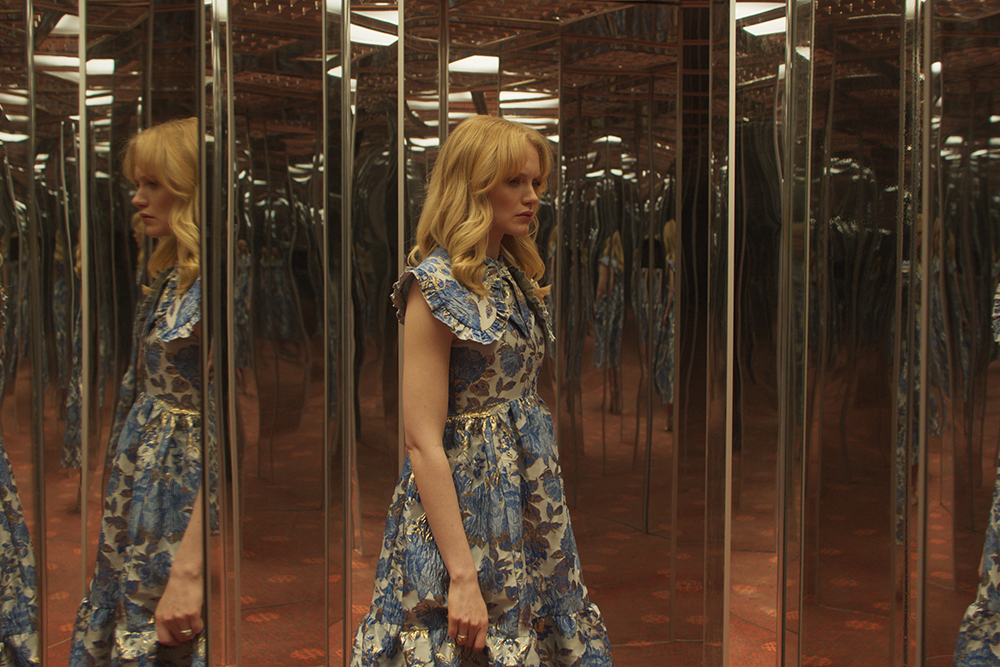
The memory is etched with cinematic clarity: a Los Angeles rooftop, bathed in the hues of a spectacular sunset, Emma Laird standing on the precipice of despair. A cigarette, a dramatic prop in her moment of crisis, smoldered between her fingers. “It was so cinematic,” she recalls, a wry smile now accompanying the recollection. “And I was crying my eyes out.” It was a scene straight out of a script, yet terrifyingly real, marking what felt like the definitive end of her American dream.
The crushing news had just arrived via phone call from her agent: the coveted role in HBO’s “Gossip Girl” reboot, a part she had painstakingly fought for, making it all the way to the screen test stage after months of relentless, often soul-crushing auditions, was going to someone else. For the young British actress, whose visa was nearing expiration and finances dwindling, it felt like the final curtain call on her Hollywood aspirations. “And I just thought, that’s it, I tried, my visa’s running out and I’m broke,” she admits, the weight of that moment still palpable in her voice. Defeated, she packed her bags and retreated across the Atlantic, back to London.
Fast forward a little over half a decade, and Emma Laird is indeed still in London. But the narrative has dramatically flipped. The city that welcomed her back in defeat now embraces her as one of the U.K.’s most electrifying rising stars. Her career trajectory, once a precarious tightrope walk, has transformed into a rocket-fueled ascent, boasting an enviable and eclectic array of high-profile projects. From the gritty depths of “Mayor of Kingstown” to the art-house allure of “The Brutalist” and the visceral thrill of “28 Years Later: The Bone Temple,” her resume is a testament to her versatility and daring choices. And with a slate of eagerly anticipated productions like “Blood on Snow,” “War,” and the highly anticipated “Neuromancer” on the horizon, her momentum shows no signs of slowing. Her current appearance at the Berlinale, celebrating “Mint”—her very first lead role—marks yet another significant milestone in an already remarkable journey.
Despite the glittering achievements, the 27-year-old remains refreshingly grounded, a rarity in an industry often consumed by ego. Part of a dwindling cohort of working-class British actors making their mark on international call sheets, Laird possesses an endearing, almost comically down-to-earth demeanor. She’s not one to bask in the glow of her successes, preferring instead a more pragmatic, self-aware approach. “I’m constantly working from a place of self-deprecation,” she confesses, taking a thoughtful sip of her matcha latte in a bustling West London café, a stone’s throw from her recently purchased home. “It does feel like a nice trajectory, but I’m too insecure to feel like I’m amazing. But I do take pride—I know when shit’s good.” And, by all accounts, “shit has been very good” indeed.
The stark contrast between her L.A. rooftop heartbreak and her current professional fulfillment couldn’t be more pronounced. Laird pinpoints a pivotal, almost spiritual career epiphany not amidst Hollywood glamour, but in a semi-freezing, mud-caked field in Yorkshire. This was the set of Nia DaCosta’s highly anticipated and viscerally gory franchise sequel, “28 Years Later: The Bone Temple.” Here, amidst the post-apocalyptic chaos, embodying the delightfully unhinged Jimmima—the most sadistic member of a murderous, wig-wearing cult led by Jack O’Connell—something profound clicked into place. “I just looked around and was like, I am living the dream,” she recounts, a genuine thrill in her voice. “I was just looking at this derelict set of a zombie apocalypse and thinking ‘This is fucking amazing—this is what I want to do!'” It was a moment of absolute clarity, a profound realization that her unconventional path was leading her exactly where she was meant to be, embracing the wild, the weird, and the wonderfully grotesque.
A career as a blood-splattered screen star was, however, far from the initial blueprint. Laird’s journey into the public eye began at the tender age of 17, when a model scout discovered her at a music festival. The opportunity prompted a dramatic shift: she quit her studies, packed her bags, and left her hometown of Chesterfield in the north of England for the bustling metropolis of London. “I was so focused on being successful,” she recalls, driven by a fierce ambition. And successful she was. For six years, she graced numerous fashion campaigns, including a notable stint for the iconic Vivienne Westwood (whose designs she would later wear to “The Bone Temple” premiere), and appeared in countless magazine shoots. It was a world of glamour and high-pressure demands, a rigorous training ground in self-presentation and resilience.
Yet, despite the outward success, a creeping disillusionment began to set in. The industry’s relentless focus on appearance and often unrealistic beauty standards took its toll. Calls from her agency to “lose some weight” became increasingly disheartening, eroding her confidence and sense of self. Having spent years surrounded by enthusiastic, creative individuals on set, many of whom recognized a spark beyond her striking looks, she was increasingly urged to explore acting. It was a suggestion that resonated deeply, offering a potential escape from the superficiality of modeling into a realm of deeper emotional and artistic expression.
The leap into acting was swift, though not without its initial challenges, culminating in that tearful L.A. rooftop moment. But fate, it seems, had a different plan. Just months after her return to London, Taylor Sheridan’s bleak, Michigan-set prison drama, “Mayor of Kingstown,” proved to be Laird’s major breakout. Her compelling debut turn alongside Jeremy Renner as Iris, a seductive escort caught in the city’s dark underworld, immediately got industry tongues wagging. Her nuanced performance, blending vulnerability with a hardened streetwise edge, garnered significant critical attention. *Variety* swiftly recognized her burgeoning talent, naming her a Brit to Watch in 2021. The momentum had finally begun, and Emma Laird was undeniably “off.”

The offers started rolling in. The Apple TV series “The Crowded Room” saw her delve into complex psychological territory, followed by a role in Kenneth Branagh’s star-studded Agatha Christie whodunnit, “A Haunting in Venice.” Then came “The Brutalist,” a critically acclaimed art-house drama where she portrayed the standoffish, and possibly antisemitic, wife of Adrien Brody’s character’s cousin. Laird humorously attributes securing this role to a serendipitous accident during the filming of “The Crowded Room,” when director Brady Corbet accidentally trapped her finger in a door. This incident, rather than causing a grievance, became an unexpected bonding experience that led to her casting. While her back-to-back schedule prevented her from fully enjoying “The Brutalist’s” awards season success, she proudly declares it was “the first thing I watched that I’ve been proud of.” “The Bone Temple” soon joined that exclusive list, solidifying her confidence in her craft and her choices.
“The Bone Temple” was more than just another impressive credit; it was a catalyst, igniting a profound craving for the “wild and the weird,” for roles that demanded daring, unconventional preparation. She speaks of delving into the twisted, almost childlike psyche of a character “raised in an apocalypse,” a process that thrilled her. This experience cemented her artistic philosophy: from here on, Emma Laird wants to be bold, bonkers, and loud. “That’s not to say to shout,” she clarifies, emphasizing nuance over volume. “But subtlety is easier to do, because you can hide behind it. Whereas in making brave choices, you run the risk of making mistakes.” For Laird, this risk is precisely where the excitement lies, where true artistry flourishes.
For the actress, while the allure of prestige, awards, and widespread acclaim are acknowledged and appreciated, they are not the primary drivers at this pivotal point in her career. Her inspiration stems from a different wellspring. “I get that you can give a beautiful performance like Jessie Buckley in ‘Hamnet,’ which was fucking amazing,” she says, praising a peer’s acclaimed work. “But what inspires me is watching people do mad stuff. So I want to make films about fairies or wizards or weird shit. I don’t want to do Shakespeare, I want to play a fish.” This declaration, delivered with characteristic wit and conviction, encapsulates her artistic rebellion against conventional expectations, her desire to explore the fantastical and the imaginative rather than adhere to traditional dramatic forms.

House/Fearless Minds/BBC
While Hollywood often leans towards the literary, Laird has her sights set on a particularly aquatic role: joining HBO’s highly anticipated “Harry Potter” series, potentially as one of the mysterious underwater Merpeople. Her dedication to the wizarding world is deep-seated; she confesses to regularly putting on one of the original films each night before sleep, a comforting ritual. However, she notes with a grin, the Merpeople don’t truly make their prominent appearance until the fourth book, “The Goblet of Fire,” so there are still a few years to wait for her potential Hogwarts enrolment.
Before any deep-sea magical endeavors, Laird is preparing for another significant television venture. “Mint,” premiering at the prestigious Berlinale, is a collaboration with fellow rising British talent Charlotte Regan, who made a splash with her critically acclaimed feature debut, “Scrapper.” In this distinctly stylized and exquisitely shot drama, Laird takes on her first lead role, portraying the love-struck daughter of a powerful crime family. No longer relegated to the sidelines, clad in blood-splattered tracksuits and fairy wings, she is front and center of the action. This newfound prominence brings with it a palpable mix of excitement and anxiety. “I’ve been doing all this work, but it’s been with these smaller, cool characters,” Laird observes, acknowledging the shift. “And it feels like now people are starting to watch me in stuff, and that’s quite scary—I have the fear of what people will think when they watch me.”
With her “nice trajectory” showing every sign of continuing its upward climb, Laird understands that conquering this fear is essential, particularly as she gravitates towards “noisier” and more demanding roles. Ironically, just a day after our conversation, an announcement confirms her casting not in a film about Shakespeare, but as the enigmatic Daphne du Maurier in “The Housekeeper,” starring alongside screen legends Helena Bonham Carter and Anthony Hopkins. This role, far from being a quiet, subtle turn, appears to perfectly align with her developing artistic manifesto. Her preliminary research into the famed author of “Rebecca,” Laird notes, has revealed du Maurier to be “loud and rich”—a presence she fully intends to embody and amplify on set when filming commences later this month.
Laird is acutely aware that her current in-demand, booked-and-busy status could have been vastly different had the call about “Gossip Girl”—a show that ultimately garnered mixed reviews and was scrapped after two seasons—gone the other way on that cinematic L.A. rooftop. It’s a poignant reminder of how life’s rejections can often be redirections, steering us towards paths far more fulfilling than the ones we initially coveted. “I think it’s a nice thing to remember—that maybe the thing you think you want is not the thing you need,” she reflects, a profound wisdom in her voice. “Who knows what would have happened, but it all worked out so well. And now it’s just a beautiful memory to look back on and think, how poetic!”
A soft laugh escapes her. “But I do remember that that was probably the best cigarette I’ve ever smoked in my life.” It’s a perfectly Emma Laird conclusion: a moment of self-deprecating humor, grounded in the reality of her past, yet underscored by the undeniable triumph of her present, and the boundless potential of a future she’s boldly crafting on her own terms.