



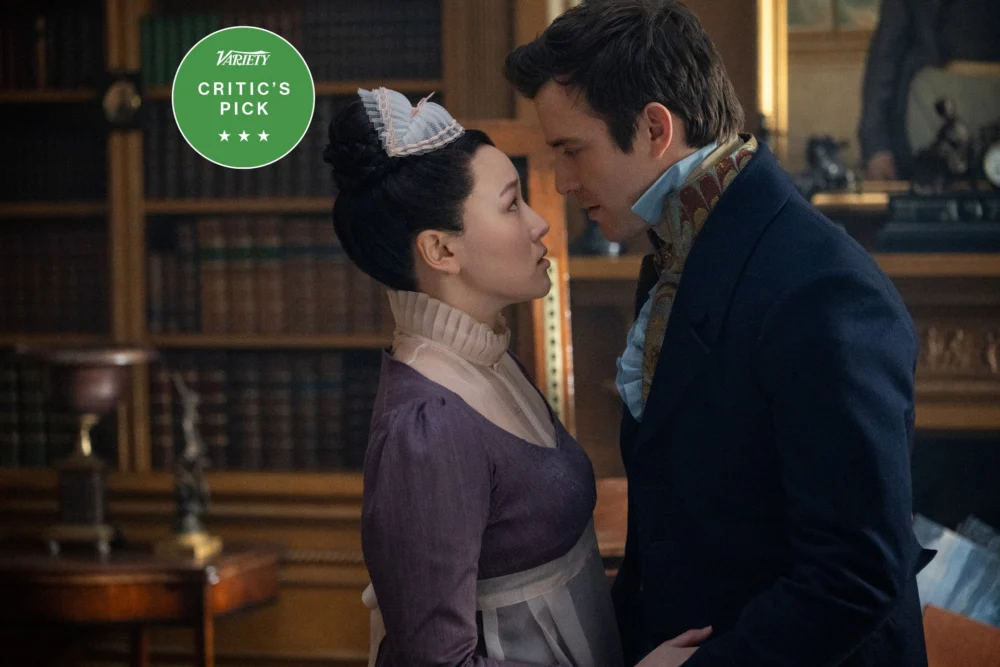
The highly anticipated second half of *Bridgerton* Season 4 unfurls with a compelling intensity, immediately immersing viewers in the aftermath of a pivotal moment. We find Sophie Baek, the spirited lady’s maid portrayed by Yerin Ha, still reeling from the electrifying kiss she shared with Benedict Bridgerton (Luke Thompson) on the back stairwell of the Bridgerton House. Yet, the initial flush of that passionate embrace is swiftly overshadowed by a profound sense of deflation. Benedict’s subsequent proposition—that she become his mistress—casts a stark, unromantic shadow over their burgeoning connection, laying bare the harsh realities and social stratifications of the Regency era.
For a 21st-century audience, such an offer might seem antiquated, even insulting. But for a woman in Regency England, particularly one of Sophie’s social standing, the implications were far more dire and deeply ingrained in the fabric of society. As Lady Whistledown (voiced by the inimitable Julie Andrews) eloquently, and often cuttingly, observes through the events of Episode 5, “Yes or No,” the position of a “mistress” was anything but glamorous. It offered precarious security, social ostracization, and a life lived in the shadows, devoid of legitimate status, inheritance rights, or the respect afforded to a wife. It was a choice born of desperation or, at best, a temporary arrangement that offered little true agency or future for the woman involved. This stark contrast between modern romantic ideals and historical limitations is where *Bridgerton* Season 4 Part 2 truly finds its footing, moving beyond the charming, albeit sometimes simplistic, fairy-tale echoes of its first half.
Indeed, while *Bridgerton* Season 4 Part 1 drew criticism for feeling like a “knock-off of Cinderella”—a somewhat predictable narrative of a disadvantaged girl catching the eye of a nobleman—the latter episodes dramatically elevate the series. They deftly navigate the complexities of passion, the profound sting of loss, and the immense stakes for high-society women grappling with the unforgiving realities of the marriage market. This shift in tone and depth transforms the season from a mere romantic fantasy into a more nuanced exploration of personal desires clashing with societal dictates, making it one of the series’ most compelling installments to date.
At the heart of this season’s narrative remains the captivating, often tumultuous, romance between Benedict and Sophie. However, the true genius of Season 4 Part 2 lies in its intricate weaving of the stories of the women orbiting this central couple. Their individual journeys of self-discovery, societal negotiation, and evolving aspirations collectively elevate this season to a standout. These are not merely supporting characters; they are vital threads in a rich tapestry that explores the multifaceted experiences of women in a world dictated by rigid social codes.
One such pivotal character is Penelope Featherington, brought to life with exquisite vulnerability by Nicola Coughlan. Fans will recall the seismic revelation in the Season 1 finale: Penelope was the clandestine voice of Lady Whistledown, using her incisive gossip pamphlet as both a shield and an escape from her life as an overlooked wallflower. Her identity, once a fiercely guarded secret and a source of clandestine power, was laid bare to the public in Season 3, a moment that, paradoxically, stripped away much of her passion for the work. Now, as a wife and mother, Penelope’s evolution is palpable. The once-driven chronicler of society’s foibles finds her priorities shifting. The thrill of the quill has been replaced by the quiet fulfillment of domesticity and the responsibilities of a new chapter. Her journey reflects a universal truth about the ebb and flow of ambition and the profound impact of life’s transitions on one’s sense of purpose, moving beyond the need for external validation to embrace a more internal sense of worth.
The season also delicately introduces us to the blossoming journey of the youngest Bridgerton, Hyacinth, portrayed with spirited innocence by Florence Hunt. As Hyacinth inches closer to her own debut into society—a milestone that, while eagerly anticipated, seems to arrive slower than she would like—*Bridgerton* meticulously underscores the paramount importance for women of her era to “marry well.” For the Bridgerton daughters, however, this imperative is compounded by the family’s romantic legacy: they are expected to find not just a husband, but a true love match. A poignant recital hosted on Hyacinth’s behalf at Bridgerton House serves as a subtle yet powerful catalyst, beginning to open the youngest Bridgerton’s eyes to the profound significance of compatibility and genuine happiness, rather than merely securing a suitable husband for status or security. It’s a gentle nudge towards a more enlightened understanding of matrimony, a concept often revolutionary in a world where marriages were primarily strategic alliances.
Conversely, Season 4 Part 2 opens the ornate doors to Stirling House, introducing viewers to the evolving narrative of Francesca Bridgerton (Hannah Dodd). Francesca, ever the composed and duty-bound Bridgerton, is initially depicted as intent on meticulously emulating her mother, Lady Violet Bridgerton (Ruth Gemmell), striving to embody the ideal wife to her husband, John (Victor Alli). Her path seems clear, defined by tradition and expectation. However, the unexpected arrival of John’s cousin and best friend, Michaela Stirling (Masali Baduza), introduces a captivating new dynamic. Michaela, with her independent spirit and perhaps unconventional worldview, becomes a mirror, subtly revealing to Francesca that there may not be a single, prescribed “perfect way to live.” This encounter hints at a broader, more expansive understanding of self and partnership, potentially challenging Francesca’s preconceived notions and opening her eyes to possibilities she had not yet considered, suggesting a path that diverges from mere emulation to genuine self-discovery.
Beyond the immediate Bridgerton family, the season skillfully enriches the narratives of several supporting characters, granting them depth and agency within the Queen’s formidable orbit. Alice Mondrich (Emma Naomi), whose family has recently ascended to the peerage, grapples with the intricate social dance of finding her footing amidst Queen Charlotte’s (Golda Rosheuvel) discerning court. Her journey highlights the challenges of navigating new societal strata, the delicate balance of maintaining one’s identity while adapting to new expectations, and the constant pressure to prove worthy of her newfound status. Simultaneously, Lady Danbury (Adjoa Andoh), a beloved stalwart of the Ton, faces her own internal conflicts. Her struggle to balance her deep-seated, close-knit friendship with the formidable Queen and her own increasingly personal desires adds a layer of poignant complexity to her character, revealing the sacrifices and compromises even the most powerful women must make in their lives.
The primary critique leveled against *Bridgerton* Season 4 Part 1—the muted romance between Sophie and Benedict—is definitively rectified in its second half. The yearning, longing, and undeniable desire that were sorely missing from their initial interactions now surge to the forefront, imbuing their relationship with the “lusty zeal” that fans have eagerly awaited. This profound shift is largely attributable to Benedict’s compelling character development. In the season’s initial episodes, he appeared adrift and unsure of himself, burdened by the duties and expectations associated with his position as the second son, often wearing it like a badge of shame. However, as the season progresses, Benedict undergoes a remarkable transformation, shedding his uncertainties and truly coming into his own. He boldly steps up for the woman he loves, demonstrating a newfound conviction and protective instinct. Crucially, he also exhibits a profound vulnerability, opening up to Sophie and sharing aspects of his identity and past, including what the narrative describes as his “fluid sexuality.” This revelation, shared within the intimate confines of their growing bond, deepens their connection, showcasing Benedict’s artistic and free-spirited nature and his capacity for profound honesty and acceptance. For devoted readers of Julia Quinn’s novels, the season finale, “Dance in the Country,” delivers an especial delight, featuring a tantalizing scene ripped directly from the pages of her beloved book, “An Offer From a Gentleman,” providing a satisfying and authentic climax to their long-awaited romance.
*Bridgerton* Season 4 Part 2 further captivates by granting unexpected depth to what might initially seem like its most villainous character: Araminta Gun (Katie Leung), also known as Lady Penwood, Sophie’s stepmother and former employer. Along with her two daughters, Rosamund Li (Michelle Mao) and Posy Li (Isabella Wei), Araminta returns to focus, not merely as a one-dimensional antagonist, but as a product of her era. While she remains undeniably ferocious and cunning, showrunner Jess Brownell meticulously highlights this twice-widowed woman’s arduous journey in a world where a woman’s relevance and security were inextricably linked to the men in her life. Araminta’s harshness, her relentless pursuit of advantageous matches for her daughters, and her cruel treatment of Sophie are reframed through the lens of survival and the desperation born of profound societal insecurity. Her character, though unlikable, becomes a potent symbol of the immense pressures and limited options faced by women, particularly those without significant independent means or male protection, in Regency society. This exploration adds a rich, empathetic layer to the season, demonstrating that even the most formidable characters are shaped by the constraints and expectations of their time.
The final chapters of *Bridgerton* Season 4 are a masterclass in storytelling, beautifully detailed in every aspect—from the exquisite costumes and lavish sets to the evocative musical scores. These episodes allow beloved characters, some from earlier seasons, to expand, grow, and undergo profound transformations, enriching the overall narrative arc of the Bridgerton universe. This careful cultivation of character development not only provides satisfying conclusions for the current season’s protagonists but also skillfully sets the stage for the remaining four love stories that await in future installments, ensuring the series’ continued narrative momentum and emotional resonance. It is, however, a persistent source of frustration that Netflix continues its practice of slicing some of its biggest series into two distinct parts. This episodic division, particularly in a romance-driven narrative like *Bridgerton*, often interrupts the delicate pacing of the love stories, disrupting the natural flow of emotional build-up and release. Yet, when all the threads converge in the poignant and exhilarating conclusion of Part 2, it becomes abundantly clear that the wait, despite its minor frustrations, was unequivocally worthwhile, delivering a season that is both deeply satisfying and exquisitely crafted.