


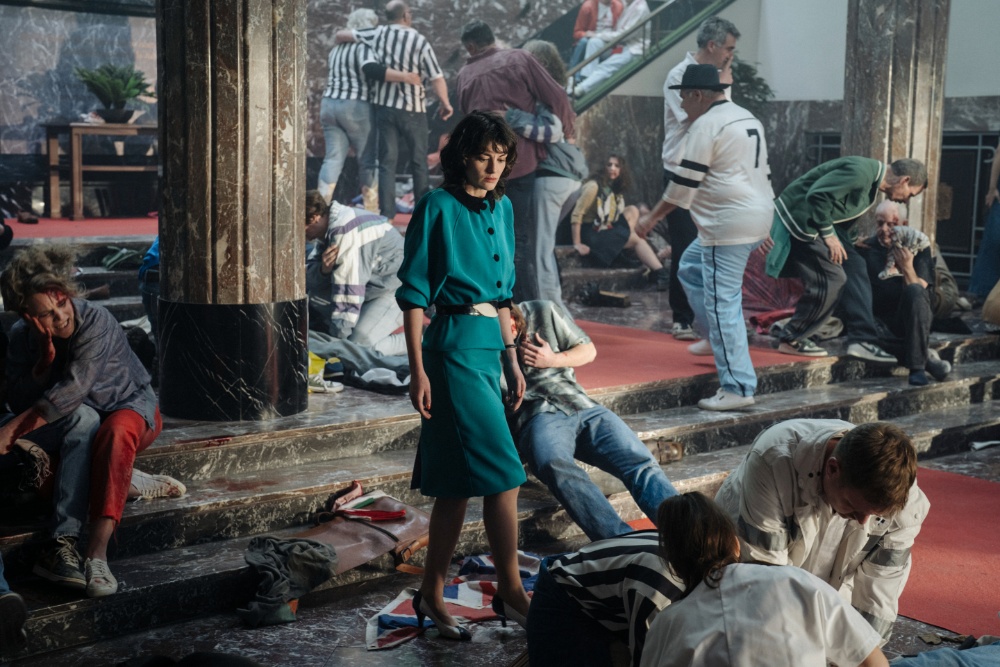
Teodora Ana Mihai’s gripping cinematic endeavor, "Heysel 85," plunges viewers into the heart of one of modern football’s darkest days, chronicling the harrowing eruption of violence that preceded a pivotal European Cup final in Brussels. Far from a mere historical recounting, Mihai masterfully constructs an engrossing political microcosm, weaving together fictionalized narratives of reporters and local leaders with raw, visceral archival footage. The film, set against the grim backdrop of the real Heysel Stadium disaster of May 29, 1985, emerges as a profound work of commentary, its meticulous aesthetic control conjuring the era with startling authenticity while simultaneously resonating with anxieties distinctly of the present moment. It is an anxiety-inducing piece of cinéma vérité, a testament to the enduring power of film to excavate truth from tragedy.
The film commences with an unsettling montage of actual news footage from that notorious day, a stark reminder of the European Cup final between Italian giants Juventus and English rivals Liverpool. An initial textual warning — "disturbing historical images may follow" — prepares the audience for the difficult journey ahead, a necessary prelude to the unflinching portrayal of chaos. This official record then seamlessly gives way to Mihai’s meticulously staged 16mm footage, executed in a documentary style that blurs the lines between reality and dramatic recreation. We are introduced to Luca (Matteo Simoni), a Belgium-based Italian reporter, whose initial foray into the day’s excitement involves interviewing an enthusiastic young Juventus fan for radio — a boy who, in a poignant revelation, turns out to be Luca’s own younger brother. The cacophonous symphony of fans surging into Heysel Stadium, a blend of authentic and dramatized sounds, envelops the viewer, crafting an atmosphere thick with anticipation and latent danger. The sole discernible artifice lies in the wider aspect ratio of the dramatized sequences, a subtle visual cue distinguishing them from the historical 4:3 televised tape.
To fully grasp the magnitude of Mihai’s cinematic achievement, one must understand the real-world catastrophe that anchors "Heysel 85." The 1985 European Cup final was meant to be a celebration of football, a clash between two of Europe’s most formidable clubs. Instead, it devolved into an unimaginable horror. Prior to kickoff, a section of Liverpool supporters charged a neutral zone occupied largely by Juventus fans, many of whom were families. The ensuing panic led to a crush against a retaining wall, which ultimately collapsed. Thirty-nine people, predominantly Italian and Belgian, lost their lives, and hundreds more were injured. The match controversially went ahead, overshadowed by the unfolding tragedy. The Heysel disaster was not merely an isolated incident but a brutal culmination of widespread football hooliganism that plagued European football, particularly English clubs, throughout the 1970s and 80s. It triggered a five-year ban for all English clubs from European competitions, a seismic event that reshaped the sport’s landscape and forced a reckoning with fan behavior, stadium safety, and institutional responsibility. Mihai’s film, by revisiting this wound, invites a crucial re-examination of how such tragedies are born and perpetuated.
With equal artistic panache, the narrative baton is passed without a cut, shifting focus to the arriving Mayor Dumont (Josse De Pauw) and his daughter, Marie (Violet Braeckman), who serves as his press attaché. Their arrival attracts both the omnipresent news cameras and the film’s frame, drawing the audience deeper into the stadium’s inner sanctums – the offices and VIP lounges. This transition trades the visceral, real game-day footage of enthusiastic fans for a dramatized tour of the otherwise unseen backrooms beneath the stands, all while the escalating roar from the crowd outside and above serves as an ominous counterpoint. Through a series of press conferences and private discussions, critical topics such as public safety are superficially broached, only to be swiftly cast aside by Dumont. His singular focus remains on the optics of the game, on projecting an image of control and grandeur, and on assiduously entertaining the arriving Italian dignitaries who have come to witness the spectacle. Yet, even before the characters themselves can fully grasp the unfolding reality, they find themselves ensnared in a disaster movie, as fragmented news and unsettling whispers begin to leak out, detailing increasingly bloody confrontations between rival fan factions. It is at this critical juncture that the conscientious Marie and Luca, propelled by a nascent sense of urgency, begin to gather crucial information, serving as vital conduits of communication by helping to translate between English, Italian, Dutch, and French, their actions foreshadowing their eventual roles as the film’s moral compasses.
Mihai’s brilliance lies in her meticulous craftsmanship, particularly in the seamless integration of authentic archival material with her fictionalized, documentary-style 16mm footage. This deliberate choice is more than an aesthetic flourish; it is a narrative strategy that elevates "Heysel 85" beyond a mere docudrama. The grainy texture of the 16mm film, evocative of the 1980s, coupled with the raw, unfiltered nature of the archival clips, creates an immersive experience that blurs the boundaries of time and perception. The wider aspect ratio of the dramatized scenes, a subtle but effective visual cue, guides the viewer’s understanding, allowing them to differentiate between historical fact and fictionalized interpretation while never disrupting the film’s relentless forward momentum. This blending technique not only enhances the film’s cinéma vérité feel but also underscores the pervasive presence of media in shaping public perception during crises, a theme that resonates profoundly in our contemporary, hyper-connected world.
As the narrative progresses, the riot spreads with the terrifying swiftness of a blazing inferno. The initial reactions among politicians and policemen, while outwardly concerned, soon betray a knowing and preemptive desire to deflect blame. It becomes chillingly clear to our empathetic heroes — Marie, the diligent attaché, and Luca, the earnest reporter — that this tragedy was not an unforeseen act of fate but a preventable catastrophe, born from unchecked egos and a catastrophic failure of leadership. As the film increasingly ropes in real clips of the day’s harrowing events, Mihai expertly cross-cuts them with snaking, claustrophobic shots through the stadium hallways. These corridors, initially bustling with anticipation, gradually become choked with bloodied figures — some injured, others tragically deceased. Marie, driven by an unwavering sense of duty, desperately tries to assess the spiraling situation while offering aid to the wounded, while Luca, his professional detachment shattered, embarks on a frantic search for his missing family, further personalizing the devastating stakes.
Teodora Ana Mihai’s filmography, notably including the Cannes Un Certain Regard prizewinner "La Civil" and Romania’s Oscar submission "Traffic," has consistently showcased her profound interest in women navigating oppressive, often patriarchal, systems. Her deliberate choice to position Marie — a woman whose insightful ideas and warnings are frequently dismissed within the male-dominated spheres of politics and sports — as a central point-of-view character is a direct extension of this recurring thematic approach. Marie embodies the often-unheard voice of reason and competence within environments where power and ego reign supreme. Mihai herself has described her venture into a major event in soccer history as coming from an "unusual suspect" — a self-aware acknowledgment of her unique perspective as a female director tackling a subject historically dominated by male narratives and perspectives. This outsider status grants her a critical distance, allowing for a fresh and incisive examination of the systemic failures that underpin the Heysel disaster.
The film’s compact 91-minute runtime, while contributing to its relentless pace, occasionally causes its thematic focus on misogyny to feel somewhat over-pronounced. Specific interactions and reactions laced with dismissiveness towards Marie, while ethically commendable in their depiction of the hostile environments women often face in sports and politics, can at times pull focus and energy from the sweeping brutality of the erupting chaos and the intricate dynamics of the larger ensemble. It is a delicate balance, as showcasing Marie’s struggle is vital to Mihai’s vision, yet the most potent "character" in "Heysel 85" is arguably the event itself – the way the disaster morphs, mutates, and ultimately consumes, spitting out bodies and exposing the cracks in institutional facades. Despite this minor aesthetic tension, "Heysel 85" remains riveting at every turn. This sustained intensity is attributable not only to Mihai’s masterful control over the frame’s chaotic movement, executed in collaboration with cinematographer Marius Panduru, but also to the astonishing realism with which the entire production is rendered. From the meticulous designs of its costumes and spaces that transport the audience back to the mid-80s, to the nuanced performances that effortlessly oscillate between the naturalistic and the profoundly symbolic, every element contributes to the film’s immersive power.
The arrival of "Heysel 85" in a FIFA World Cup year serves as a stark, timely reminder of the entrenched entwinement between the world’s most popular sport and the insidious forces of corruption and institutional negligence. Josse De Pauw’s portrayal of Mayor Dumont, a man singularly inclined to compartmentalize inconvenient truths and pass the buck of responsibility, is wonderfully pathetic – a chillingly accurate depiction of political expediency over human safety. However, the true human soul of the film resides in the utterly committed work of Violet Braeckman as Marie and Matteo Simoni as Luca. They embody well-meaning individuals thrust into morally ambiguous and perilous circumstances, each torn in their own way between the deeply personal call of family duty and the broader imperative of social responsibility. Their journeys underscore the individual courage required to confront systemic failure.
Even as the immediate mayhem appears to be temporarily brought under control, the film leaves looming questions unresolved, particularly concerning the intractable dilemma of how to defuse the ticking time bomb represented by 60,000 rowdy spectators enclosed within a stadium. This very specific problem fans outward into a powerful and universal metaphor for confronting an incendiary, agonized world teetering on the precipice of chaos. There isn’t a single moment in "Heysel 85" that doesn’t feel drenched in gasoline, brimming with a palpable sense of impending doom. And while its events transpired over four decades ago, watching them unfold in Mihai’s unflinching portrayal becomes a stark, almost unbearable reflection of what it feels like to live in a world perpetually on the edge of a knife, where the echoes of past mistakes continue to reverberate with terrifying clarity. The film serves as a potent, essential warning, reminding us that the human cost of negligence, hubris, and silenced voices is a burden we can ill afford to forget.