
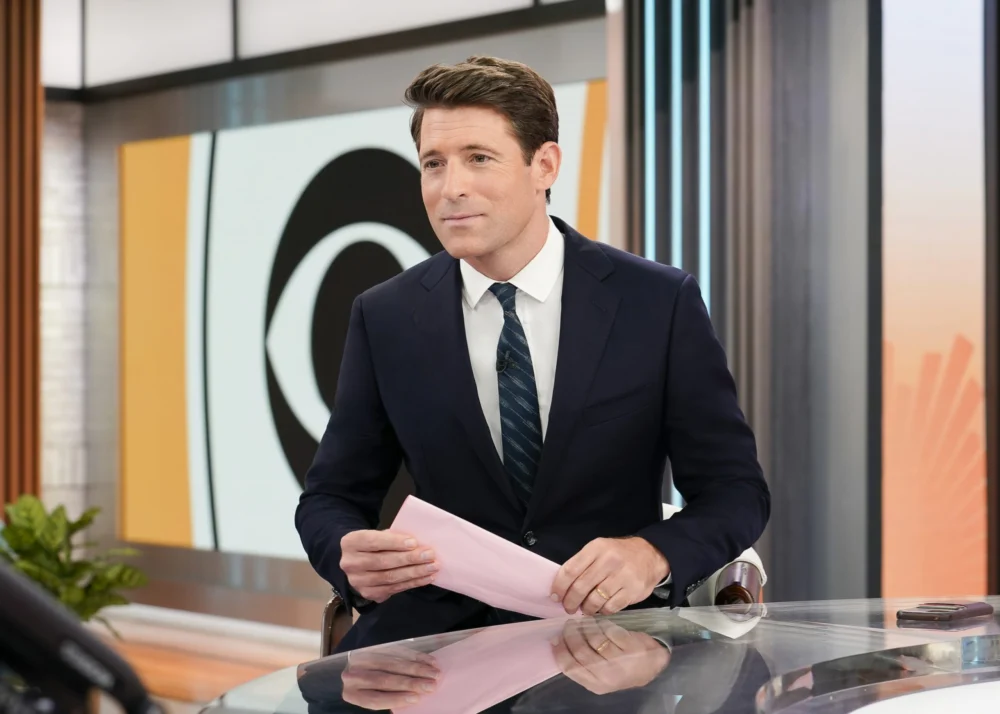
The highly anticipated new era for CBS Evening News under its freshly appointed anchor, Tony Dokoupil, commenced not with the carefully orchestrated debut envisioned by network executives, but rather with an urgent, unscheduled broadcast on a Saturday evening. What was meant to be a strategic Monday launch, designed to reintroduce the venerable news program to a national audience, was dramatically upended by a sudden, seismic geopolitical event: a stunning attack on Venezuela by U.S. forces, swiftly followed by the extraction of the country’s embattled president, Nicolás Maduro. This unforeseen international crisis thrust Dokoupil, a veteran of CBS News’ morning programming, into the anchor chair days ahead of schedule, marking a truly unprecedented beginning to what promises to be a challenging tenure.
The urgency of the situation was undeniable. As news of the Venezuela developments broke, rival networks quickly mobilized their top talent for weekend duty, with NBC’s Tom Llamas and CNN’s Kaitlan Collins among those stepping up to provide critical coverage. For CBS, the moment demanded an equally decisive response, making Dokoupil’s early appearance not just a strategic option, but an absolute necessity. Thus, on Saturday evening, he found himself leading the network’s flagship evening broadcast, tasked with briefing a nation hungry for information on a rapidly unfolding international incident. He was supported by a dedicated team of correspondents, including Charlie D’Agata and Scott MacFarlane, and notably, conducted an extensive three-segment interview with U.S. Secretary of Defense Pete Hegseth, highlighting the gravity and official perspective of the unfolding events.
Yet, this urgent debut immediately presented a striking contrast with the very philosophy Dokoupil and CBS News had been promoting in the run-up to his official start. Just days prior, promotional spots had featured Dokoupil articulating a clear editorial vision, one that emphasized a departure from traditional newsroom biases. In these promos, he boldly declared, "on too many stories the press missed the story. Because we’ve taken into account the perspective of advocates and not the average American. Or we put too much weight in the analysis of academics or elites, and not enough on you.” This promise of centering the “average American” perspective, of engaging directly with everyday citizens rather than relying solely on institutional voices, was a cornerstone of his new mandate. However, his inaugural Saturday broadcast, dominated by expert analysis and an interview with a powerful government official like Secretary Hegseth—a figure who undoubtedly embodies a level of power and influence far beyond that of the "average American"—contained no direct input from the very demographic Dokoupil had vowed to champion. This immediate divergence underscored the inherent tension between a pre-planned editorial vision and the unpredictable realities of breaking news, setting a complex tone for his leadership.
Dokoupil steps into this high-profile role at a particularly tumultuous period for CBS Evening News. For years, the program has languished in third place in the fiercely competitive landscape of evening news, consistently trailing behind ABC’s World News Tonight and NBC’s NBC Nightly News. This persistent struggle is not merely a matter of ratings; it reflects a deeper challenge in connecting with and retaining a loyal viewership in an increasingly fragmented media environment. The landscape of news consumption has been irrevocably altered by the advent of 24/7 cable news, the proliferation of digital platforms, and the immediacy of social media. In this context, the traditional evening news broadcast, once a singular source of daily information, must now fight harder than ever to prove its relevance and offer unique value.
Adding to the program’s woes, recent attempts to revitalize the broadcast have, paradoxically, resulted in further viewer erosion. A two-anchor format, featuring Maurice DuBois and John Dickerson, was trialed in an effort to inject fresh energy, but ultimately failed to resonate with audiences, leading to a decline in viewership. This strategic misstep highlighted a pattern that has plagued CBS Evening News for years: a revolving door of anchors. While NBC’s Nightly News has maintained remarkable stability, relying on just four anchors over approximately four decades, CBS has frequently swapped out its lead journalists. In just a few years, the network cycled through Scott Pelley, Jeff Glor, and Norah O’Donnell before settling on Dokoupil. Such frequent changes, while sometimes driven by a desire for reinvention, inevitably make the arduous task of fostering deep, lasting ties with a loyal viewership considerably more difficult. Audiences often crave consistency and familiarity in their news anchors, viewing them as trusted guides through complex world events. A constant rotation disrupts this vital connection, making it harder for any single anchor to build the indispensable rapport necessary for long-term success.
Dokoupil’s appointment also comes under the watchful eye of Bari Weiss, the recently installed editor-in-chief of CBS News, whose arrival has been met with both intrigue and controversy. Weiss joined the Paramount Skydance-backed outlet after it reportedly spent a staggering $150 million to acquire her opinion site, The Free Press. Her background, primarily rooted in opinion journalism and digital media, presents a significant departure from the traditional profiles of leaders within mainstream television news organizations. Indeed, she has no prior experience running a broadcast news operation, a fact that, according to insiders, has begun to manifest in recent weeks.
Her tenure has already been marked by notable controversies. Most prominently, she reportedly ordered a fully-vetted 60 Minutes report to be held, sparking concerns within the newsroom about editorial independence and the sanctity of established journalistic processes. This incident, among others, has led to growing frustration among CBS News staffers, who reportedly feel that a disproportionate focus on Weiss’s managerial decisions and her perceived lack of understanding of broadcast news operations is diverting attention and resources away from the serious, impactful journalism produced by CBS News reporters. It’s a delicate balance: while CBS News itself demonstrated its robust reporting capabilities by being early to break news of the Venezuela strikes in the crucial early hours of Saturday morning, along with key details about the planning of these operations, the internal focus on leadership dynamics risks overshadowing these journalistic achievements.
Compounding Dokoupil’s already challenging start, Weiss’s leadership has also been criticized for not adequately paving the way for her new anchor. The announcement of Dokoupil’s early-January start was made a mere three weeks prior to his debut. In the highly competitive world of network news, such a short lead time is virtually unheard of. Typically, TV networks dedicate far longer periods to touting the looming arrival of a new evening anchor. These campaigns often involve extensive national advertising, comprehensive digital rollouts, and crucial tours where the journalist meets with executives and staffers at affiliate stations across the nation. During these visits, local anchors are encouraged to promote the upcoming national telecast to their viewers, creating a unified promotional front. Three weeks provided CBS with precious little time to implement such crucial promotional tactics, including outdoor advertising or a sustained digital campaign to truly ignite public interest. A digital video distributed just this week, showing Dokoupil striving to capture the attention of passers-by in Grand Central Terminal, regrettably underscored the reality that, despite his morning show experience, he was not yet a widely recognized figure to the broader public, a critical asset for an evening news anchor.
In preparation for Dokoupil’s arrival, CBS has implemented subtle but significant tweaks to the venerable program’s visual presentation. The screen now features fewer cluttered graphics, an intentional move designed to reduce visual distractions and allow viewers to focus more intently on the anchor’s delivery and the substance of the news. This aesthetic refinement is part of a broader effort to modernize the broadcast while retaining its gravitas, a program that, after all, carries historical ties to the legendary Walter Cronkite. However, the true test remains whether Dokoupil, even with a cleaner visual backdrop, can consistently offer viewers deeper insights and unique perspectives, especially after a full day of cable news and broadcast networks’ special reports have already delved into the major headlines. On his inaugural Saturday, the program ultimately ceded a significant portion of its valuable airtime to Secretary Hegseth, further highlighting the immediate challenges of differentiating the broadcast amidst a crowded news landscape.
It is important to view Saturday’s broadcast not as a definitive blueprint for Dokoupil’s tenure, but rather as an extraordinary deviation forced by circumstance. As Cronkite famously used to say, it was not necessarily “the way it is.” Dokoupil’s initial plans involved a far more ground-level approach, with intentions to launch his run by visiting various U.S. towns and cities, directly engaging with the "average Americans" he promised to highlight. Indeed, on Saturday evening, even as he anchored from New York for the breaking news, he was also simultaneously holding forth at KPIX, CBS’s San Francisco station, underscoring his planned engagement with local markets. He is slated to return to New York for his official Monday broadcast, which will, for now, delay the extensive cross-country travel plans originally envisioned to commence by the middle of next week.
As Dokoupil signed off on that eventful Saturday night with the simple phrase, “That’s another day in America and the world,” it was clear that for him, and for the network, it was anything but just "another day." It was an unexpected, high-stakes initiation into one of the most visible and challenging roles in broadcast journalism, marking the beginning of what promises to be a complex, demanding, and ultimately longer journey to redefine CBS Evening News for a new era. The path ahead is fraught with the challenges of reclaiming viewership, navigating internal leadership dynamics, and consistently delivering on a promise of journalistic distinction, all while striving to connect with a nation eager for trustworthy, resonant news coverage.