

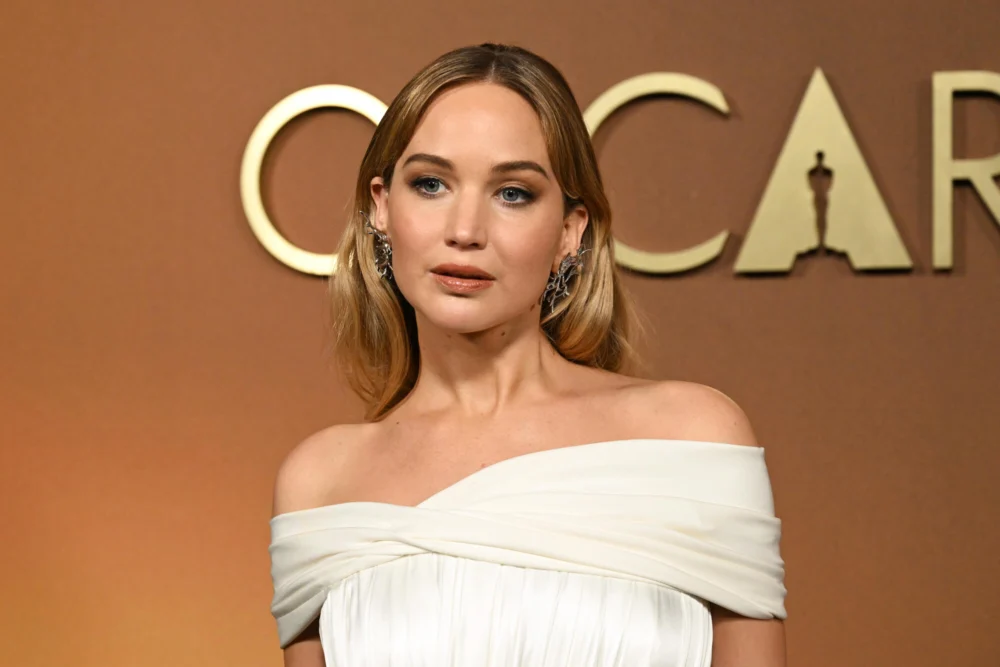
Jennifer Lawrence, known for her candidness and down-to-earth demeanor, recently offered a revealing glimpse into the often-awkward world of filming intimate scenes in Hollywood. During a live recording of the popular "Happy Sad Confused" podcast, the Oscar-winning actress shared a surprisingly pragmatic take: she finds filming sex scenes significantly less uncomfortable with co-stars she doesn’t know personally, suggesting that professional distance can, in fact, facilitate intimacy on screen. This counterintuitive preference underscores a unique perspective on the challenges actors face when blurring the lines between performance and personal connection.
Lawrence illuminated her reasoning by drawing a sharp contrast between two distinct experiences. On one hand, she cited her recent work on Lynne Ramsay’s psychological drama, "Die My Love," where she shared a nude scene with Robert Pattinson, a fellow actor she had not known prior to filming. On the other, she recalled the palpable awkwardness of kissing Josh Hutcherson in the later installments of "The Hunger Games" franchise, a co-star with whom she had developed a deep, platonic friendship over years of working together. Her reflections offer a window into the nuanced psychological landscape actors navigate when portraying physical intimacy.
"Die My Love," a film that plunges into the tumultuous mind of a new mother grappling with psychosis, required Lawrence and Pattinson to confront raw vulnerability from the outset. Their demanding nude scene was scheduled for the very first day of production, a scenario that might seem daunting to many. Yet, Lawrence found this initial plunge into intimacy with a relative stranger to be an unexpected advantage. "It was actually easier that way because Rob and I did not know each other, which is kind of better, you know?" she explained, highlighting the inherent professional boundary that existed. This distance, she implied, allowed them to approach the scene as a purely technical and artistic endeavor, free from the complications of an established personal relationship.
The dynamic with Josh Hutcherson, her long-standing co-star from "The Hunger Games," presented an entirely different challenge. Over the course of four blockbuster films, Lawrence and Hutcherson grew up together on screen and forged a close, sibling-like bond off-screen. Their characters, Katniss Everdeen and Peeta Mellark, shared a complex romantic arc, necessitating numerous kisses and intimate moments. "Like in ‘Hunger Games,’ me and Josh Hutcherson would have to kiss and that’s like… Imagine it. You know, it’s weirder and so yeah, doing it with a stranger is preferable," Lawrence elaborated. This sentiment resonates with many who have experienced the uncomfortable crossing of platonic lines, even in a professional context. The pre-existing personal affection and comfort, ironically, became a hurdle rather than a help when tasked with simulating romantic passion. It speaks to the delicate balance actors must strike between authenticity and artificiality, where a stranger can sometimes provide the necessary blank canvas for performance.
The conversation around on-screen intimacy has evolved significantly in Hollywood, particularly with the widespread adoption of intimacy coordinators. These professionals are now integral to many productions, serving as advocates for actors, choreographing scenes, and ensuring a safe, consensual environment for intimate work. "Die My Love" reportedly employed an intimacy coordinator for Lawrence and Pattinson’s scenes, a standard practice aimed at enhancing actor comfort and streamlining the process. However, Lawrence revealed last year on the "Las Culturistas" podcast that, despite the presence of a coordinator, she felt they weren’t strictly necessary in this particular instance.
Her comfort stemmed largely from her experience with Pattinson. "We did not have [an intimacy coordinator], or maybe we did but we didn’t really… I felt really safe with Rob," she recounted. She painted a picture of a professional and respectful working relationship, emphasizing Pattinson’s character. "He is not pervy and very in love with [partner] Suki Waterhouse. We mostly were just talking about our kids and relationships." This revelation highlights that while intimacy coordinators are vital tools, the individual chemistry and mutual respect between actors can also significantly contribute to a safe set. Lawrence’s comfort with Pattinson was so profound that she noted, "There was never any weird like, ‘Does he think I like him?’ If there was a little bit of that I would probably have an intimacy coordinator."
This comment segued into a more profound observation about power dynamics in the industry, particularly concerning female actors. Lawrence courageously shared a stark reality: "A lot of male actors get offended if you don’t want to fuck them, and then the punishment starts. He was not like that." This powerful statement underscores the persistent challenges many actresses face, where professional boundaries can be misinterpreted or even deliberately violated by male co-stars who conflate on-screen intimacy with real-world interest. It speaks volumes about the necessity of intimacy coordinators and a cultural shift towards consent and respect in an industry historically fraught with imbalances of power. Pattinson’s respectful demeanor, focused on professional collaboration rather than personal entitlement, provided Lawrence with a rare sense of security, allowing her to fully commit to her role without the added burden of managing a co-star’s potential misinterpretations.
Beyond the complexities of co-star dynamics, Lawrence also reflected on her evolving relationship with her own body image and nudity on camera. In a separate interview, she shared how her perspective shifted significantly between filming "No Hard Feelings," an R-rated comedy where she went full frontal, and "Die My Love." For "No Hard Feelings," she admitted to adhering to a strict diet and intense workout regimen, a common practice for actors preparing for revealing scenes, driven by societal and personal pressures to conform to idealized body standards.
However, her approach to "Die My Love" was strikingly different and deeply liberating. "I don’t care about nudity. I’m not sensitive about it," Lawrence asserted, explaining her commitment to director Lynne Ramsay’s artistic vision. "I wanted Lynne to have total freedom artistically." The most transformative factor, she revealed, was her pregnancy during the filming of "Die My Love." "I think being pregnant took a lot of, like, vanity anxiety away," she explained. The physical and emotional demands of pregnancy, combined with a rigorous 15-hour workday schedule, stripped away any inclination towards superficial concerns. "Like, what was I gonna do? Not eat? I was working 15 hours a day. I was just tired."
This newfound perspective allowed her to embrace a radical level of body acceptance on screen. She recounted an anecdote where the production team sent her a close-up shot of cellulite, asking if she wanted it retouched. Her response was immediate and unequivocal: "No. That’s an ass." This powerful declaration is a testament to her embrace of authenticity and a refreshing defiance of the often-unrealistic beauty standards prevalent in cinema. It champions the portrayal of real bodies, cellulite and all, on screen, aligning with a growing movement for greater body diversity and realism in media. Lawrence’s willingness to display her pregnant, working body without vanity speaks to a maturity in her craft and a profound personal liberation that transcends the typical demands of Hollywood.
Jennifer Lawrence’s candid revelations provide invaluable insight into the intricate world of film production, particularly the psychological and physical demands of intimate scenes. Her pragmatic preference for working with strangers, her appreciation for respectful co-stars like Robert Pattinson, and her liberating experience with body image during pregnancy collectively paint a picture of an actress who navigates her profession with refreshing honesty and a deep commitment to artistic integrity. Her willingness to share these experiences not only demystifies aspects of filmmaking but also contributes to broader, crucial conversations about consent, respect, and body positivity within the entertainment industry. For those eager to witness this period of artistic and personal evolution, "Die My Love" is now available to stream on Mubi.