
A profound cultural and political schism has erupted at the heart of America’s premier performing arts institution, the John F. Kennedy Center for the Performing Arts, culminating in a striking legal threat against a celebrated jazz musician. Ambassador Richard Grenell, the Trump-appointed president of the Kennedy Center, has declared the organization’s intent to pursue $1 million in damages from acclaimed jazz vibraphonist and drummer Chuck Redd. The contentious demand follows Redd’s eleventh-hour cancellation of the center’s beloved annual free Christmas Eve concert, a direct protest against the controversial renaming of the venerable institution to “The Donald J. Trump and The John F. Kennedy Memorial Center for the Performing Arts.”
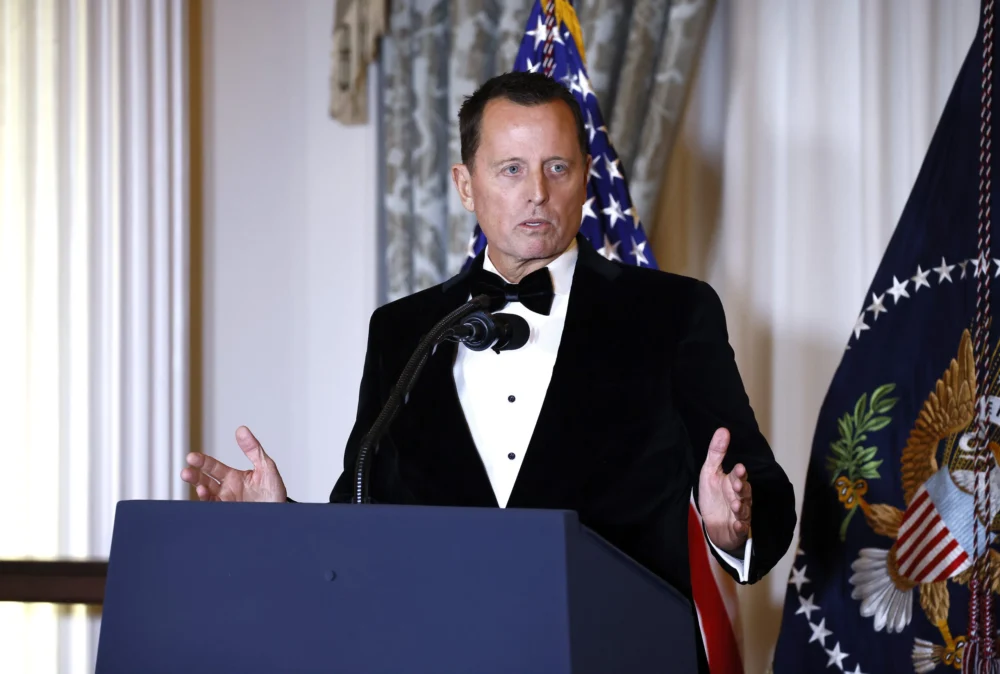
The dispute has quickly escalated from an artistic statement to a high-stakes legal confrontation, drawing sharp lines in the sand between artistic freedom, political loyalty, and the stewardship of national cultural treasures. In a letter dispatched on December 26 to Redd, a communication first brought to light by the Associated Press, Grenell did not mince words. He asserted, “Your decision to withdraw at the last moment — explicitly in response to the Center’s recent renaming, which honors President Trump’s extraordinary efforts to save this national treasure — is classic intolerance and very costly to a non-profit Arts institution.” The letter further underscored the gravity of the center’s position, stating unequivocally, “This is your official notice that we will seek $1 million in damages from you for this political stunt.”
The unfolding drama at the Kennedy Center is not merely a localized squabble but reflects a wider national debate over the politicization of public institutions and the increasingly volatile intersection of art and politics. Grenell, a prominent figure in the Trump administration, amplified his stance on social media, posting on X (formerly Twitter) on Saturday night about the legal threat to Redd. He declared, “The left is boycotting the Arts because Trump is supporting the Arts. But we will not let them cancel shows without consequences. The Arts are for everyone — and the Left is mad about it.” This statement frames the cancellation as part of a broader ideological battle, portraying Redd’s action not as a personal protest but as a partisan attack on cultural access.
At the time of reporting, Chuck Redd had not publicly responded to the request for comment regarding the lawsuit threat. However, his initial rationale for canceling the concert had been clear. Redd, who has led the annual Christmas Eve jazz concert at the Kennedy Center since 2006, explained his decision to the AP on Wednesday. He recounted, “When I saw the name change on the Kennedy Center website and then hours later on the building, I chose to cancel our concert.” For Redd, the abrupt alteration of the institution’s identity was a breach of principle too significant to ignore, compelling him to withdraw from a long-standing and cherished tradition.
The renaming itself was a swift and unexpected move. On December 19, workers were observed adding Trump’s name to the center’s façade. This physical alteration followed by just one day a contentious claim from the White House on December 18, asserting that the Kennedy Center’s board of trustees – members handpicked by President Trump – had “voted unanimously to rename the facility the ‘Trump Kennedy Center.’” This assertion immediately sparked outrage and legal challenges, as many questioned the legality and propriety of such a change to a federally designated landmark.
Indeed, legal experts were quick to point out that the renaming appeared to contravene existing federal law. The John F. Kennedy Center for the Performing Arts was established by a 1964 federal act, specifically naming it in honor of the slain president. Crucially, this legislation explicitly prohibits the board of trustees from adding any other name to the building’s exterior. The law was designed to preserve the unique dedication to President Kennedy, cementing his legacy in perpetuity through this cultural institution. In response to what many viewed as an unlawful unilateral action, U.S. Representative Joyce Beatty (D-Ohio) took decisive action. On Monday, December 22, she filed a lawsuit against both Trump and the Kennedy Center’s board, seeking a court order to compel the removal of Trump’s name. Her suit argues that any alteration to the center’s name requires an act of Congress, not merely a board vote, thereby challenging the very foundation of the renaming.
The canceled Christmas Eve concert, a staple of Washington D.C.’s holiday calendar, was scheduled for Tuesday, December 24, at 12 p.m. on the center’s Millennium Stage. The event was promoted as an opportunity for the community to “Join in our annual Christmas Eve Jazz Jam for an evening of music that’ll fill you with holiday cheer.” Its cancellation left a void for many families and jazz enthusiasts who had come to rely on the festive, free performance as part of their holiday traditions. The abrupt end to this beloved event underscores the tangible impact of the political dispute on public access to the arts.
Chuck Redd, at 67 years old, is a figure of considerable stature within the jazz world. His official website describes him as “well known internationally as a performer on drums and vibraphone” and notes his extensive discography, featuring on more than 80 recordings. Redd’s illustrious career began early; he started recording and touring at the tender age of 21 when he joined the iconic Charlie Byrd Trio. He further solidified his reputation as a member of the legendary Great Guitars ensemble, which included Barney Kessel, Byrd, and Herb Ellis. His dedication to jazz education and preservation is also notable, having served as artist-in-residence at the Smithsonian Jazz Café in Washington, D.C., from 2004 to 2008, and as a member of the Smithsonian Jazz Masterworks Orchestra for 15 years. His decision to cancel, therefore, comes not from a nascent artist seeking attention, but from a deeply respected veteran whose actions carry significant weight within the artistic community.
The dramatic events at the Kennedy Center are part of a broader strategic shift initiated by Donald Trump during his second term, which began in February 2025. One of his initial actions was the termination of Deborah Rutter, the long-serving president of the Kennedy Center. Following Rutter’s dismissal, Trump appointed Richard Grenell, who had previously served as ambassador to Germany during Trump’s first administration and later as his envoy for special missions. This leadership change was accompanied by a wholesale restructuring of the center’s governance; Trump systematically ousted Democratic board members, replacing them with his own political allies. This concerted effort to reshape the center’s leadership and artistic direction signals a clear intent to align its operations with a specific political and cultural agenda.
Trump’s criticisms of the Kennedy Center, and indeed of the broader arts landscape, have been vociferous and consistent. He has frequently expressed disdain for what he terms “woke programming,” articulating a vision for the arts that he believes should reflect traditional American values, devoid of what he perceives as political or progressive messaging. On Truth Social, Trump articulated his new directive for the center, stating, “NO MORE DRAG SHOWS, OR OTHER ANTI-AMERICAN PROPAGANDA — ONLY THE BEST.” This statement directly reflects his administration’s cultural priorities. An incident reported by CNN in June, where four drag queens attended the opening night of “Les Misérables” at the Kennedy Center and were seated below the presidential box, had reportedly drawn ire from Trump and his supporters, further fueling the narrative of “woke” encroachment on traditional arts institutions.
The concept of “woke programming,” as invoked by Trump and Grenell, typically refers to art that is seen as promoting social justice, diversity, equity, and inclusion, often challenging traditional norms or conservative viewpoints. Critics argue that such programming is divisive or deviates from the primary purpose of artistic expression, while proponents contend that art has a vital role in reflecting society, fostering dialogue, and providing platforms for diverse voices. The clash over this definition is at the heart of the current conflict, suggesting a fundamental disagreement over the very purpose and function of a national performing arts center.
For a public institution like the Kennedy Center, which relies on a blend of federal funding, private donations, and ticket sales, such controversies can have profound implications. Artistic programming decisions, often made through a delicate balance of artistic merit, public appeal, and mission alignment, now face heightened political scrutiny. The threat of a $1 million lawsuit against a respected artist could have a chilling effect across the artistic community, potentially discouraging performers from taking principled stands on political or social issues for fear of financial reprisal. This raises critical questions about artistic freedom and the extent to which artists can express their conscience without facing professional jeopardy, especially when performing at institutions under political patronage.
Moreover, the legal challenge posed by Representative Beatty’s lawsuit against the renaming is significant. Should the courts side with Beatty, it would not only invalidate the board’s decision but also underscore the importance of legislative oversight in the governance of national monuments and cultural symbols. It would reaffirm that federal laws establishing these institutions carry more weight than executive or board mandates, potentially setting a precedent for similar disputes in the future. The outcome of this legal battle will determine whether the name of the Kennedy Center, a symbol of American cultural aspiration and remembrance, remains solely dedicated to its namesake or if it can be unilaterally altered by a presidential administration.
The unfolding saga at the Kennedy Center is more than a dispute over a name or a canceled concert; it is a microcosm of a larger cultural struggle for the soul of America’s public institutions. It highlights the inherent tensions when political power seeks to redefine artistic spaces and the principled stands artists are willing to take in defense of their values and the integrity of their craft. As the legal proceedings unfold and the cultural debate intensifies, the future identity and artistic direction of the Donald J. Trump and John F. Kennedy Memorial Center for the Performing Arts—or simply, the John F. Kennedy Center for the Performing Arts—hang precariously in the balance, a testament to the enduring power of both politics and art to shape our national narrative.